Hexagonal window
A hexagonal window, also called a Melnikov's window or honeycomb window,[1] is a hexagonal window, resembling a honeycomb cell or the crystal lattice of graphite. The window can be vertically or horizontally oriented, and openable or fixed. It can also be regular or elongated in shape and can have a separator (mullion or transom).
Overview
Typically, the cellular window[2] is used for an attic or as a decorative feature, but it can also be a major architectural element to provide the natural lighting inside buildings. The hexagonal window is relatively rare and associated with such architectural styles as constructivism,[3] functionalism[4] and, occasionally, cubism.
History
Attic hexagonal windows were occasionally used in the Northern European manor architecture of the 19th century. The concept became popular thanks to the Russian constructivist architect Konstantin Melnikov,[5][6] whose own famous house had 124 hexagonal windows, which were the main source of light as ceiling lights were not provided in many rooms.[7][8] Cellular windows are also a feature of the Scandinavian functionalism architecture of the 1940s–1960s and are a kind of synthesis of tradition and modernism in the architecture.[9]
Today, hexagonal windows may be associated with honeycomb houses, a concept proposed by architect Frank Lloyd Wright[10] and explore an idea of organic architecture, which considers the nature as a main source of architectural imagination.[11][self-published source]
Gallery
-
 Mustonen House, 1870, Joensuu, Finland.
 -
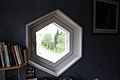 Internal view of hexagonal window.
 -
 Melnikov House, Moscow, Russia.
 -
 Hexagonal window with diagonal mullions, Melnikov House.
 -
 Vertical chain of hexagonal windows, Finland, 1950s.
 -
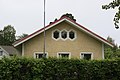 Triple cellular window in private mansion in Finland, 1960s.
 -
 Hexagonal window at the right bottom part of building, Finnish functionalism.


.jpg)


See also
References
- ^ "About the State Melnikovs Museum". muar.ru. Schusev State Museum of Architecture. Archived from the original on 6 October 2016. Retrieved 5 October 2016.
- ^ "Fenster kaufen" (in German). 6 October 2021.
- ^ Higgott, Andrew (31 May 2018). Key Modern Architects: 50 Short Histories of Modern Architecture. Bloomsbury Publishing. ISBN 978-1-4742-6506-5. Retrieved 22 June 2021.
- ^ Schweden, Ausstellung Architektur im 20 Jahrhundert; Andersson, Thorbjörn; Architekturmuseum, Deutsches; Eriksson, Eva (1998). Sweden. Prestel. p. 126. ISBN 978-3-7913-1936-0. Retrieved 22 June 2021.
{{cite book}}: CS1 maint: numeric names: authors list (link) - ^ Bayer, Patricia (1992). Art Deco Architecture: Design, Decoration, and Detail from the Twenties and Thirties. H.N. Abrams. p. 23. ISBN 978-0-8109-1923-5. Retrieved 22 June 2021.
- ^ Иконников, Андрей Владимирович (1988). Russian Architecture of the Soviet Period. Raduga Publishers. p. 134. ISBN 978-5-05-001178-7. Retrieved 22 June 2021.
- ^ "The Modernist: House-studio of Konstantin Melnikov". The Constructivist Project. theconstructivistproject.com. 31 August 2014. Archived from the original on 11 January 2017. Retrieved 4 October 2016.
- ^ Winstanley, Tim (14 June 2012). "AD Classics: Melnikov House / Konstantin Melnikov". archdaily.com. Retrieved 4 October 2016.
- ^ "Immediate Benefits of Replacing Your Home's Windows". 12 August 2024. Retrieved 7 February 2026.
- ^ "About The Hanna House". Stanford University. hannahousetours.stanford.edu. Retrieved 4 October 2016.
- ^ Rogers, Wally (29 February 2016). Close-Up View of Froebel's Kindergarten with Frank Lloyd Wright at the Drawing Table. Xlibris Corporation. p. 505. ISBN 978150358180-7.
Content Disclaimer
Informasi ini disarikan dari Wikipedia dan disajikan kembali untuk tujuan edukasi. Konten tersedia di bawah lisensi CC BY-SA 3.0. Kami tidak bertanggung jawab atas ketidakakuratan data yang bersumber dari kontribusi publik tersebut.
- The information displayed on this website is sourced in part or in whole from Wikipedia and has been adapted for the purpose of restating it. We strive to provide accurate and relevant information, however:
- There is no guarantee of absolute accuracy. Wikipedia is an open, collaborative project that can be edited by anyone, so information is subject to change.
- It is not intended to constitute professional advice. The content displayed is for informational and educational purposes only. For important decisions (e.g., medical, legal, or financial), please consult a professional.
- Content copyright. Wikipedia is licensed under the Creative Commons Attribution-ShareAlike License (CC BY-SA). This means that content may be reused with appropriate attribution and shared under a similar license.
- Responsible use. Any risk arising from the use of information from this website is entirely the responsibility of the user.