Hanes–Woolf plot

In biochemistry, a Hanes–Woolf plot, Hanes plot, or plot of against is a graphical representation of enzyme kinetics in which the ratio of the initial substrate concentration to the reaction velocity is plotted against . It is based on the rearrangement of the Michaelis–Menten equation shown below:


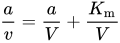
where is the Michaelis constant and is the limiting rate.[1]


J. B. S. Haldane stated, reiterating what he and K. G. Stern had written in their book,[2] that this rearrangement was due to Barnet Woolf.[3] It was one of three transformations introduced by Woolf. It was first published by C. S. Hanes, who did himself not use it as a plot.[4] Hanes said that the use of linear regression to determine kinetic parameters from this type of linear transformation generates the best fit between observed and calculated values of , rather than .[4]: 1415

Starting from the Michaelis–Menten equation:

we can take reciprocals of both sides of the equation to obtain the equation underlying the Lineweaver–Burk plot:

which can be multiplied on both sides by to give


Thus in the absence of experimental error data a plot of against yields a straight line of slope , an intercept on the ordinate of and an intercept on the abscissa of .


Like other techniques that linearize the Michaelis–Menten equation, the Hanes–Woolf plot was used historically for rapid determination of the kinetic parameters , and , but it has been largely superseded by nonlinear regression methods that are significantly more accurate and no longer computationally inaccessible. It remains useful, as a means to present data graphically.

See also
References
- ^ The term maximum rate is often used, but not recommended by the IUBMB; see Cornish-Bowden, A (2014). "Current IUBMB recommendations on enzyme nomenclature and kinetics". Persp. Sci. 1 (1–6): 74–87. Bibcode:2014PerSc...1...74C. doi:10.1016/j.pisc.2014.02.006.
- ^ Haldane, John Burdon Sanderson; Stern, Kurt Günter (1932). Allgemeine Chemie der Enzyme. Wissenschaftliche Forschungsberichte, Naturwissenschaftliche Reihe, herausgegeben von Dr. Raphael Eduard Liesegang. Vol. 28. Dresden and Leipzig: Theodor Steinkopff. pp. 119–120. OCLC 964209806.
- ^ Haldane, John Burdon Sanderson (1957). "Graphical methods in enzyme chemistry". Nature. 179 (4564): 832. Bibcode:1957Natur.179R.832H. doi:10.1038/179832b0. S2CID 4162570.
- ^ a b Hanes, Charles Samuel (1932). "Studies on plant amylases: The effect of starch concentration upon the velocity of hydrolysis by the amylase of germinated barley". Biochemical Journal. 26 (5): 1406–1421. doi:10.1042/bj0261406. PMC 1261052. PMID 16744959.
Content Disclaimer
Informasi ini disarikan dari Wikipedia dan disajikan kembali untuk tujuan edukasi. Konten tersedia di bawah lisensi CC BY-SA 3.0. Kami tidak bertanggung jawab atas ketidakakuratan data yang bersumber dari kontribusi publik tersebut.
- The information displayed on this website is sourced in part or in whole from Wikipedia and has been adapted for the purpose of restating it. We strive to provide accurate and relevant information, however:
- There is no guarantee of absolute accuracy. Wikipedia is an open, collaborative project that can be edited by anyone, so information is subject to change.
- It is not intended to constitute professional advice. The content displayed is for informational and educational purposes only. For important decisions (e.g., medical, legal, or financial), please consult a professional.
- Content copyright. Wikipedia is licensed under the Creative Commons Attribution-ShareAlike License (CC BY-SA). This means that content may be reused with appropriate attribution and shared under a similar license.
- Responsible use. Any risk arising from the use of information from this website is entirely the responsibility of the user.