Hamming scheme
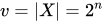
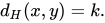
The Hamming scheme, named after Richard Hamming, is also known as the hyper-cubic association scheme, and it is the most important example for coding theory.[1][2][3] In this scheme the set of binary vectors of length and two vectors are -th associates if they are Hamming distance apart.


Recall that an association scheme is visualized as a complete graph with labeled edges. The graph has vertices, one for each point of and the edge joining vertices and is labeled if and are -th associates. Each edge has a unique label, and the number of triangles with a fixed base labeled having the other edges labeled and is a constant depending on but not on the choice of the base. In particular, each vertex is incident with exactly edges labeled ; is the valency of the relation The in a Hamming scheme are given by


Here, and The matrices in the Bose-Mesner algebra are matrices, with rows and columns labeled by vectors In particular the -th entry of is if and only if


References
- ^ P. Delsarte and V. I. Levenshtein, “Association schemes and coding theory,“ IEEE Trans. Inf. Theory, vol. 44, no. 6, pp. 2477–2504, 1998.
- ^ P. Camion, "Codes and Association Schemes: Basic Properties of Association Schemes Relevant to Coding," in Handbook of Coding Theory, V. S. Pless and W. C. Huffman, Eds., Elsevier, The Netherlands, 1998.
- ^ F. J. MacWilliams and N. J. A. Sloane, The Theory of Error-Correcting Codes, Elsevier, New York, 1978.
Content Disclaimer
Informasi ini disarikan dari Wikipedia dan disajikan kembali untuk tujuan edukasi. Konten tersedia di bawah lisensi CC BY-SA 3.0. Kami tidak bertanggung jawab atas ketidakakuratan data yang bersumber dari kontribusi publik tersebut.
- The information displayed on this website is sourced in part or in whole from Wikipedia and has been adapted for the purpose of restating it. We strive to provide accurate and relevant information, however:
- There is no guarantee of absolute accuracy. Wikipedia is an open, collaborative project that can be edited by anyone, so information is subject to change.
- It is not intended to constitute professional advice. The content displayed is for informational and educational purposes only. For important decisions (e.g., medical, legal, or financial), please consult a professional.
- Content copyright. Wikipedia is licensed under the Creative Commons Attribution-ShareAlike License (CC BY-SA). This means that content may be reused with appropriate attribution and shared under a similar license.
- Responsible use. Any risk arising from the use of information from this website is entirely the responsibility of the user.