Haefliger structure
In mathematics, a Haefliger structure on a topological space is a generalization of a foliation of a manifold, introduced by André Haefliger in 1970.[1][2] Any foliation on a manifold induces a special kind of Haefliger structure, which uniquely determines the foliation.
Definition
A codimension- Haefliger structure on a topological space consists of the following data:


- a cover of by open sets ;
- a collection of continuous maps ;
- for every , a diffeomorphism between open neighbourhoods of and with ;

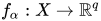


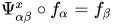
such that the continuous maps from to the sheaf of germs of local diffeomorphisms of satisfy the 1-cocycle condition



- for


The cocycle is also called a Haefliger cocycle.

More generally, , piecewise linear, analytic, and continuous Haefliger structures are defined by replacing sheaves of germs of smooth diffeomorphisms by the appropriate sheaves.

Examples and constructions
Pullbacks
An advantage of Haefliger structures over foliations is that they are closed under pullbacks. More precisely, given a Haefliger structure on , defined by a Haefliger cocycle , and a continuous map , the pullback Haefliger structure on is defined by the open cover and the cocycle . As particular cases we obtain the following constructions:


- Given a Haefliger structure on and a subspace , the restriction of the Haefliger structure to is the pullback Haefliger structure with respect to the inclusion
- Given a Haefliger structure on and another space , the product of the Haefliger structure with is the pullback Haefliger structure with respect to the projection


Foliations
Recall that a codimension- foliation on a smooth manifold can be specified by a covering of by open sets , together with a submersion from each open set to , such that for each there is a map from to local diffeomorphisms with



whenever is close enough to . The Haefliger cocycle is defined by


- germ of at u.


As anticipated, foliations are not closed in general under pullbacks but Haefliger structures are. Indeed, given a continuous map , one can take pullbacks of foliations on provided that is transverse to the foliation, but if is not transverse the pullback can be a Haefliger structure that is not a foliation.


Classifying space
Two Haefliger structures on are called concordant if they are the restrictions of Haefliger structures on to and .
![{\displaystyle X\times [0,1]}](https://wikimedia.org/api/rest_v1/media/math/render/svg/cd76f8aa27cdb748a869ec11fc6548bcab6d396b)


There is a classifying space for codimension- Haefliger structures which has a universal Haefliger structure on it in the following sense. For any topological space and continuous map from to the pullback of the universal Haefliger structure is a Haefliger structure on . For well-behaved topological spaces this induces a 1:1 correspondence between homotopy classes of maps from to and concordance classes of Haefliger structures.

References
- Anosov, D.V. (2001) [1994], "Haefliger structure", Encyclopedia of Mathematics, EMS Press
- ^ Haefliger, André (1970). "Feuilletages sur les variétés ouvertes". Topology. 9 (2): 183–194. doi:10.1016/0040-9383(70)90040-6. ISSN 0040-9383. MR 0263104.
- ^ Haefliger, André (1971). "Homotopy and integrability". Manifolds--Amsterdam 1970 (Proc. Nuffic Summer School). Lecture Notes in Mathematics, Vol. 197. Vol. 197. Berlin, New York: Springer-Verlag. pp. 133–163. doi:10.1007/BFb0068615. ISBN 978-3-540-05467-2. MR 0285027.
Content Disclaimer
Informasi ini disarikan dari Wikipedia dan disajikan kembali untuk tujuan edukasi. Konten tersedia di bawah lisensi CC BY-SA 3.0. Kami tidak bertanggung jawab atas ketidakakuratan data yang bersumber dari kontribusi publik tersebut.
- The information displayed on this website is sourced in part or in whole from Wikipedia and has been adapted for the purpose of restating it. We strive to provide accurate and relevant information, however:
- There is no guarantee of absolute accuracy. Wikipedia is an open, collaborative project that can be edited by anyone, so information is subject to change.
- It is not intended to constitute professional advice. The content displayed is for informational and educational purposes only. For important decisions (e.g., medical, legal, or financial), please consult a professional.
- Content copyright. Wikipedia is licensed under the Creative Commons Attribution-ShareAlike License (CC BY-SA). This means that content may be reused with appropriate attribution and shared under a similar license.
- Responsible use. Any risk arising from the use of information from this website is entirely the responsibility of the user.