Gevrey class
In mathematics, the Gevrey classes on a domain , introduced by Maurice Gevrey,[1] are spaces of functions 'between' the space of analytic functions and the space of smooth (infinitely differentiable) functions . In particular, for , the Gevrey class , consists of those smooth functions such that for every compact subset there exists a constant , depending only on , such that[2]



Where denotes the partial derivative of order (see multi-index notation).


When , coincides with the class of analytic functions , but for there are compactly supported functions in the class that are not identically zero (an impossibility in ). It is in this sense that they interpolate between and . The Gevrey classes find application in discussing the smoothness of solutions to certain partial differential equations: Gevrey originally formulated the definition while investigating the homogeneous heat equation, whose solutions are in .[2]


Application
Gevrey functions are used in control engineering for trajectory planning.[3] [4] A typical example is the function
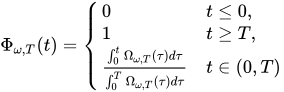
with
![{\displaystyle \Omega _{\omega ,T}(t)={\begin{cases}0&t\notin [0,T],\\\exp \left({\frac {-1}{\left([1-{\frac {t}{T}}]~{\frac {t}{T}}\right)^{\omega }}}\right)&t\in (0,T)\end{cases}}}](https://wikimedia.org/api/rest_v1/media/math/render/svg/b918b949e8135a9643abe45fe24f334fe23e4806)
and Gevrey order

See also
References
- ^ Gevrey, Maurice (1918). "Sur la nature analytique des solutions des équations aux dérivées partielles. Premier mémoire". Annales scientifiques de l'École Normale Supérieure. 35: 129–190. doi:10.24033/asens.706.
- ^ a b Rodino, L. (Luigi) (1993). Linear partial differential operators in Gevrey spaces. Singapore: World Scientific. ISBN 981-02-0845-6. OCLC 28693208.
- ^ Schaum, Alexander; Meurer, Thomas (2020). Control of PDE systems (lecture notes).
- ^ Utz, Tilman; Graichen, Knut; Kugi, Andreas (2010). "Trajectory planning and receding horizon tracking control of a quasilinear diffusion-convection-reaction system". Proceedings 8th IFAC Symposium "Nonlinear Control Systems" (NOLCOS). 43 (14). Bologna (Italy): 587–592. doi:10.3182/20100901-3-IT-2016.00215.
Content Disclaimer
Informasi ini disarikan dari Wikipedia dan disajikan kembali untuk tujuan edukasi. Konten tersedia di bawah lisensi CC BY-SA 3.0. Kami tidak bertanggung jawab atas ketidakakuratan data yang bersumber dari kontribusi publik tersebut.
- The information displayed on this website is sourced in part or in whole from Wikipedia and has been adapted for the purpose of restating it. We strive to provide accurate and relevant information, however:
- There is no guarantee of absolute accuracy. Wikipedia is an open, collaborative project that can be edited by anyone, so information is subject to change.
- It is not intended to constitute professional advice. The content displayed is for informational and educational purposes only. For important decisions (e.g., medical, legal, or financial), please consult a professional.
- Content copyright. Wikipedia is licensed under the Creative Commons Attribution-ShareAlike License (CC BY-SA). This means that content may be reused with appropriate attribution and shared under a similar license.
- Responsible use. Any risk arising from the use of information from this website is entirely the responsibility of the user.