Geometric programming
A geometric program (GP) is an optimization problem of the form
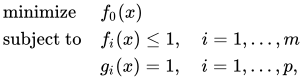
where are posynomials and are monomials. In the context of geometric programming (unlike standard mathematics), a monomial is a function from to defined as


where and . A posynomial is any sum of monomials.[1][2]


Geometric programming is closely related to convex optimization: any GP can be made convex by means of a change of variables.[2] GPs have numerous applications, including component sizing in IC design,[3][4] aircraft design,[5] maximum likelihood estimation for logistic regression in statistics, and parameter tuning of positive linear systems in control theory.[6]
Convex form
Geometric programs are not in general convex optimization problems, but they can be transformed to convex problems by a change of variables and a transformation of the objective and constraint functions. In particular, after performing the change of variables and taking the log of the objective and constraint functions, the functions , i.e., the posynomials, are transformed into log-sum-exp functions, which are convex, and the functions , i.e., the monomials, become affine. Hence, this transformation transforms every GP into an equivalent convex program.[2] In fact, this log-log transformation can be used to convert a larger class of problems, known as log-log convex programming (LLCP), into an equivalent convex form.[7]


Software
Several software packages exist to assist with formulating and solving geometric programs.
- MOSEK is a commercial solver capable of solving geometric programs as well as other non-linear optimization problems.
- CVXOPT is an open-source solver for convex optimization problems.
- GPkit is a Python package for cleanly defining and manipulating geometric programming models. There are a number of example GP models written with this package here.
- GGPLAB is a MATLAB toolbox for specifying and solving geometric programs (GPs) and generalized geometric programs (GGPs).
- CVXPY is a Python-embedded modeling language for specifying and solving convex optimization problems, including GPs, GGPs, and LLCPs.[7]
See also
References
- ^ Richard J. Duffin; Elmor L. Peterson; Clarence Zener (1967). Geometric Programming. John Wiley and Sons. p. 278. ISBN 0-471-22370-0.
- ^ a b c S. Boyd, S. J. Kim, L. Vandenberghe, and A. Hassibi. A Tutorial on Geometric Programming. Retrieved 20 October 2019.
- ^ M. Hershenson, S. Boyd, and T. Lee. Optimal Design of a CMOS Op-amp via Geometric Programming. Retrieved 8 January 2019.
- ^ S. Boyd, S. J. Kim, D. Patil, and M. Horowitz. Digital Circuit Optimization via Geometric Programming. Retrieved 20 October 2019.
- ^ W. Hoburg and P. Abbeel. Geometric programming for aircraft design optimization. AIAA Journal 52.11 (2014): 2414-2426.
- ^ Ogura, Masaki; Kishida, Masako; Lam, James (2020). "Geometric Programming for Optimal Positive Linear Systems". IEEE Transactions on Automatic Control. 65 (11): 4648–4663. arXiv:1904.12976. Bibcode:2020ITAC...65.4648O. doi:10.1109/TAC.2019.2960697. ISSN 0018-9286. S2CID 140222942.
- ^ a b A. Agrawal, S. Diamond, and S. Boyd. Disciplined Geometric Programming. Retrieved 8 January 2019.
Content Disclaimer
Informasi ini disarikan dari Wikipedia dan disajikan kembali untuk tujuan edukasi. Konten tersedia di bawah lisensi CC BY-SA 3.0. Kami tidak bertanggung jawab atas ketidakakuratan data yang bersumber dari kontribusi publik tersebut.
- The information displayed on this website is sourced in part or in whole from Wikipedia and has been adapted for the purpose of restating it. We strive to provide accurate and relevant information, however:
- There is no guarantee of absolute accuracy. Wikipedia is an open, collaborative project that can be edited by anyone, so information is subject to change.
- It is not intended to constitute professional advice. The content displayed is for informational and educational purposes only. For important decisions (e.g., medical, legal, or financial), please consult a professional.
- Content copyright. Wikipedia is licensed under the Creative Commons Attribution-ShareAlike License (CC BY-SA). This means that content may be reused with appropriate attribution and shared under a similar license.
- Responsible use. Any risk arising from the use of information from this website is entirely the responsibility of the user.