Generating function (physics)

In physics, and more specifically in Hamiltonian mechanics, a generating function is, loosely, a function whose partial derivatives generate the differential equations that determine a system's dynamics. Common examples are the partition function of statistical mechanics, the Hamiltonian, and the function which acts as a bridge between two sets of canonical variables when performing a canonical transformation.
In canonical transformations
There are four basic generating functions, summarized by the following table:[1]
| Generating function | Its derivatives |
|---|---|
| and | |
| and | |
| and | |
| and |


Example
Sometimes a given Hamiltonian can be turned into one that looks like the harmonic oscillator Hamiltonian, which is

For example, with the Hamiltonian
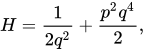
where p is the generalized momentum and q is the generalized coordinate, a good canonical transformation to choose would be
| 1 |

This turns the Hamiltonian into
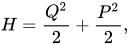
which is in the form of the harmonic oscillator Hamiltonian.
The generating function F for this transformation is of the third kind,
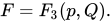
To find F explicitly, use the equation for its derivative from the table above,

and substitute the expression for P from equation (1), expressed in terms of p and Q:
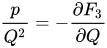
Integrating this with respect to Q results in an equation for the generating function of the transformation given by equation (1):
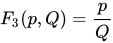
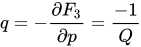
To confirm that this is the correct generating function, verify that it matches (1):
See also
References
- ^ Goldstein, Herbert; Poole, C. P.; Safko, J. L. (2001). Classical Mechanics (3rd ed.). Addison-Wesley. p. 373. ISBN 978-0-201-65702-9.
Content Disclaimer
Informasi ini disarikan dari Wikipedia dan disajikan kembali untuk tujuan edukasi. Konten tersedia di bawah lisensi CC BY-SA 3.0. Kami tidak bertanggung jawab atas ketidakakuratan data yang bersumber dari kontribusi publik tersebut.
- The information displayed on this website is sourced in part or in whole from Wikipedia and has been adapted for the purpose of restating it. We strive to provide accurate and relevant information, however:
- There is no guarantee of absolute accuracy. Wikipedia is an open, collaborative project that can be edited by anyone, so information is subject to change.
- It is not intended to constitute professional advice. The content displayed is for informational and educational purposes only. For important decisions (e.g., medical, legal, or financial), please consult a professional.
- Content copyright. Wikipedia is licensed under the Creative Commons Attribution-ShareAlike License (CC BY-SA). This means that content may be reused with appropriate attribution and shared under a similar license.
- Responsible use. Any risk arising from the use of information from this website is entirely the responsibility of the user.