Gate capacitance
In electronics, gate capacitance is the capacitance of the gate terminal of a field-effect transistor (FET). It can be expressed as the absolute capacitance of the gate of a transistor, or as the capacitance per unit area of an integrated circuit technology, or as the capacitance per unit width of minimum-length transistors in a technology.
In generations of approximately Dennard scaling of metal-oxide-semiconductor FETs (MOSFETs), the capacitance per unit area has increased inversely with device dimensions. Since the gate area has gone down by the square of device dimensions, the gate capacitance of a transistor has gone down in direct proportion with device dimensions. With Dennard scaling, the capacitance per unit of gate width has remained approximately constant; this measurement can include gate–source and gate–drain overlap capacitances. Other scalings are not uncommon; the voltages and gate oxide thicknesses have not always decreased as rapidly as device dimensions, so the gate capacitance per unit area has not increased as fast, and the capacitance per transistor width has sometimes decreased over generations.[1]
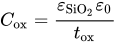
The intrinsic gate capacitance (that is, ignoring fringing fields and other details) for a silicon-dioxide-insulated gate can be calculated from thin-oxide capacitance per unit area as:

where:[2]
- AG is the gate area
- is the thin-oxide capacitance per unit area, where
- εSiO2 = 3.9 is the relative permittivity of silicon dioxide
- ε0 = 8.854×10⁻¹² F/m is the vacuum permittivity
- tox is the oxide thickness.
References
- ^ A. P. Godse; U. A. Bakshi (2009). Solid State Devices And Circuits. Technical Publications. pp. 4–8. ISBN 9788184316681.[permanent dead link]
- ^ Plusquellic, Jim. "VLSI slides". Retrieved 2 May 2021.
 | This technology-related article is a stub. You can help Wikipedia by adding missing information. |
Content Disclaimer
Informasi ini disarikan dari Wikipedia dan disajikan kembali untuk tujuan edukasi. Konten tersedia di bawah lisensi CC BY-SA 3.0. Kami tidak bertanggung jawab atas ketidakakuratan data yang bersumber dari kontribusi publik tersebut.
- The information displayed on this website is sourced in part or in whole from Wikipedia and has been adapted for the purpose of restating it. We strive to provide accurate and relevant information, however:
- There is no guarantee of absolute accuracy. Wikipedia is an open, collaborative project that can be edited by anyone, so information is subject to change.
- It is not intended to constitute professional advice. The content displayed is for informational and educational purposes only. For important decisions (e.g., medical, legal, or financial), please consult a professional.
- Content copyright. Wikipedia is licensed under the Creative Commons Attribution-ShareAlike License (CC BY-SA). This means that content may be reused with appropriate attribution and shared under a similar license.
- Responsible use. Any risk arising from the use of information from this website is entirely the responsibility of the user.