Functional square root
In mathematics, a functional square root (sometimes called a half iterate) is a square root of a function with respect to the operation of function composition. In other words, a functional square root of a function g is a function f satisfying f(f(x)) = g(x) for all x.
Notation
Notations expressing that f is a functional square root of g are f = g[1/2] and f = g1/2[citation needed][dubious – discuss], or rather f = g 1/2 (see Iterated function), although this leaves the usual ambiguity with taking the function to that power in the multiplicative sense, just as f ² = f ∘ f can be misinterpreted as x ↦ f(x)².
History
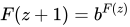
- The functional square root of the exponential function (now known as a half-exponential function) was studied by Hellmuth Kneser in 1950,[1] later providing the basis for extending tetration to non-integer heights in 2017.[2]
- The solutions of f(f(x)) = x over (the involutions of the real numbers) were first studied by Charles Babbage in 1815, and this equation is called Babbage's functional equation.[3] A particular solution is f(x) = (b − x)/(1 + cx) for bc ≠ −1. Babbage noted that for any given solution f, its functional conjugate Ψ−1∘ f ∘ Ψ by an arbitrary invertible function Ψ is also a solution. In other words, the group of all invertible functions on the real line acts on the subset consisting of solutions to Babbage's functional equation by conjugation.

Solutions
A systematic procedure to produce arbitrary functional n-roots (including arbitrary real, negative, and infinitesimal n) of functions relies on the solutions of Schröder's equation.[4][5][6] Infinitely many trivial solutions exist when the domain of a root function f is allowed to be sufficiently larger than that of g.

Examples
- f(x) = 2x2 is a functional square root of g(x) = 8x4.
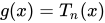
- A functional square root of the nth Chebyshev polynomial, , is , which in general is not a polynomial.
- is a functional square root of .




- sin[2](x) = sin(sin(x)) [red curve]
- sin[1](x) = sin(x) = rin(rin(x)) [blue curve]
- sin[1/2](x) = rin(x) = qin(qin(x)) [orange curve], although this is not unique, the opposite - rin being a solution of sin = rin ∘ rin, too.
- sin[1/4](x) = qin(x) [black curve above the orange curve]
- sin[–1](x) = arcsin(x) [dashed curve]
Using this extension, sin[1/2](1) can be shown to be approximately equal to 0.90871.[7]
(See.[8] For the notation, see [1] Archived 2022-12-05 at the Wayback Machine.)
See also
References
- ^ Kneser, H. (1950). "Reelle analytische Lösungen der Gleichung φ(φ(x)) = ex und verwandter Funktionalgleichungen". Journal für die reine und angewandte Mathematik. 187: 56–67. doi:10.1515/crll.1950.187.56. S2CID 118114436.
- ^ Paulsen, W.; Cowgill, S. (March 2017). "Solving in the complex plane" (PDF). Advances in Computational Mathematics. 43: 1–22. doi:10.1007/s10444-017-9524-1. S2CID 9402035. Archived from the original (PDF) on 2019-04-12.
- ^ Jeremy Gray and Karen Parshall (2007) Episodes in the History of Modern Algebra (1800–1950), American Mathematical Society, ISBN 978-0-8218-4343-7
- ^ Schröder, E. (1870). "Ueber iterirte Functionen". Mathematische Annalen. 3 (2): 296–322. doi:10.1007/BF01443992. S2CID 116998358.
- ^ Szekeres, G. (1958). "Regular iteration of real and complex functions". Acta Mathematica. 100 (3–4): 361–376. doi:10.1007/BF02559539.
- ^ Curtright, T.; Zachos, C.; Jin, X. (2011). "Approximate solutions of functional equations". Journal of Physics A. 44 (40) 405205. arXiv:1105.3664. Bibcode:2011JPhA...44N5205C. doi:10.1088/1751-8113/44/40/405205. S2CID 119142727.
- ^ Helms, Gottfried (2008). "Continuous iteration of functions having a powerseries" (PDF). Archived from the original (PDF) on 2020-04-21.
- ^ Curtright, T. L. Evolution surfaces and Schröder functional methods Archived 2014-10-30 at the Wayback Machine.
Content Disclaimer
Informasi ini disarikan dari Wikipedia dan disajikan kembali untuk tujuan edukasi. Konten tersedia di bawah lisensi CC BY-SA 3.0. Kami tidak bertanggung jawab atas ketidakakuratan data yang bersumber dari kontribusi publik tersebut.
- The information displayed on this website is sourced in part or in whole from Wikipedia and has been adapted for the purpose of restating it. We strive to provide accurate and relevant information, however:
- There is no guarantee of absolute accuracy. Wikipedia is an open, collaborative project that can be edited by anyone, so information is subject to change.
- It is not intended to constitute professional advice. The content displayed is for informational and educational purposes only. For important decisions (e.g., medical, legal, or financial), please consult a professional.
- Content copyright. Wikipedia is licensed under the Creative Commons Attribution-ShareAlike License (CC BY-SA). This means that content may be reused with appropriate attribution and shared under a similar license.
- Responsible use. Any risk arising from the use of information from this website is entirely the responsibility of the user.