Freesia
| Freesia | |
|---|---|

| |
| Cultivated freesias | |
Scientific classification 
| |
| Kingdom: | Plantae |
| Clade: | Embryophytes |
| Clade: | Tracheophytes |
| Clade: | Spermatophytes |
| Clade: | Angiosperms |
| Clade: | Monocots |
| Order: | Asparagales |
| Family: | Iridaceae |
| Subfamily: | Crocoideae |
| Tribe: | Freesieae |
| Genus: | Freesia Eckl. ex Klatt |
| Type species | |
| Freesia refracta (Jacquin) Klatt
| |
| Synonyms[1] | |
| |
Freesia is a genus of herbaceous perennial flowering plants in the family Iridaceae, first described as a genus in 1866 by Christian Friedrich Ecklon (1886) and named after the German botanist and medical practitioner, Friedrich Freese (1795–1876). It is native to the eastern side of southern Africa, from Kenya south to South Africa, most species being found in Cape Provinces.[1] Species of the former genus Anomatheca are now included in Freesia.[1] The plants commonly known as "freesias", with fragrant funnel-shaped flowers, are cultivated hybrids of a number of Freesia species. Some other species are also grown as ornamental plants.
Description
They are herbaceous plants which grow from a conical corm 1–2.5 cm (1⁄2–1 in) diameter, which sends up a tuft of narrow leaves 10–30 cm (4–12 in) long, and a sparsely branched stem 10–40 cm (4–16 in) tall bearing a few leaves and a loose one-sided spike of flowers with six petals. Many species have fragrant narrowly funnel-shaped flowers, although those formerly placed in the genus Anomatheca, such as F. laxa, have flat flowers.
Freesias are used as food plants by the larvae of some Lepidoptera species including the large yellow underwing.[citation needed]
Systematics
The genus was named in honor of Friedrich Heinrich Theodor Freese (1795–1876), a German physician.[2]
- Species[1]
- Freesia andersoniae L.Bolus - the Cape Provinces, Free State
- Freesia caryophyllacea (Burm.f.) N.E.Br. (syn. F. elimensis L.Bolus, F. parva N.E.Br., F. xanthospila (DC.) Klatt) - Heuningrug region in the Cape Provinces
- Freesia corymbosa (Burm.f.) N.E.Br. (syn. F. armstrongii W.Watson, F. brevis N.E.Br., F. aurea Hend., F. odorata (G.Lodd. ex Bosse) Eckl. ex Klatt) - the Cape Provinces
- Freesia fergusoniae L.Bolus - the Cape Provinces
- Freesia fucata J.C.Manning & Goldblatt - Hoeks River Valley in the Cape Provinces
- Freesia grandiflora (Baker) Klatt - Zaire, Tanzania, Malawi, Mozambique, Zambia, Zimbabwe, Eswatini, northeastern South Africa
- Freesia laxa (Thunb.) Goldblatt & J.C.Manning (syn. F. cruenta (Lindl.) Klatt) - from Rwanda + Kenya south to the Cape Provinces; naturalized in Madeira, Mauritius, Réunion, Australia, Florida, Argentina
- Freesia leichtlinii Klatt (syn. F. middlemostii F.Barker, F. muirii N.E.Br., Freesia alba G.L.Mey. = F. leichtlinii subsp. alba (G.L.Mey.) J.C.Manning & Goldblatt) - the Cape Provinces; naturalized in Corsica, California, Florida, Argentina
- Freesia marginata J.C.Manning & Goldblatt - the Cape Provinces
- Freesia occidentalis L.Bolus (syn. F. framesii L.Bolus) - the Cape Provinces
- Freesia praecox J.C.Manning & Goldblatt - the Cape Provinces
- Freesia refracta (Jacq.) Klatt (syn. F. hurlingii L.Bolus) - the Cape Provinces; naturalized in France, Canary Islands, Madeira, Bermuda, St. Helena
- Freesia sparrmanii (Thunb.) N.E.Br. - Langeberg in the Cape Provinces
- Freesia speciosa L.Bolus (syn. F. flava (E.Phillips & N.E.Br.) N.E.Br.) - the Cape Provinces
- Freesia verrucosa (B.Vogel) Goldblatt & J.C.Manning (syn. F. juncea (Pourr.) Klatt) - the Cape Provinces
- Freesia viridis (Aiton) Goldblatt & J.C.Manning - Namibia, the Cape Provinces
Species of the former genus Anomatheca are now included in Freesia:[1]
- Anomatheca cruenta Lindl. = Freesia laxa subsp. laxa
- Anomatheca grandiflora Baker = Freesia grandiflora
- Anomatheca juncea (Pourr.) Ker Gawl. = Freesia verrucosa
- Anomatheca laxa (Thunb.) Goldblatt = Freesia laxa
- Anomatheca verrucosa (B.Vogel) Goldblatt = Freesia verrucosa
- Anomatheca viridis (Aiton) Goldblatt = Freesia viridis
- Anomatheca xanthospila (DC.) Ker Gawl. = Freesia caryophyllacea
Cultivation and uses
The plants usually called "freesias" in horticulture and floristry are derived from crosses made in the 19th century between Freesia refracta and Freesia leichtlinii. Numerous cultivars have been bred from these species and the pink- and yellow-flowered forms of Freesia corymbosa. Modern tetraploid cultivars have flowers ranging from white to yellow, pink, red and blue-mauve. They are mostly cultivated professionally in the Netherlands by about 80 growers.[3] Freesias can be readily increased from seed. Due to their specific and pleasing scent, they are often used in hand creams, shampoos, candles, etc.[citation needed]; however, the flowers themselves are mainly used in wedding bouquets.
Freesia laxa (formerly called Lapeirousia laxa or Anomatheca cruenta) is one of the other species of the genus which is commonly cultivated. Smaller than the scented freesia cultivars, it has flat rather than cup-shaped flowers.[4][5]
-
 Freesia plants in native habitat
 -
 Freesia alba (F. leichtlinii subsp. alba)
 -
 Freesia caryophyllacea
 -
 Freesia corymbosa
 -
 Freesia grandiflora
 -
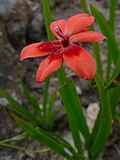 Freesia laxa
 -
 Freesia refracta (garden cultivar)
 -
 Variety of freesia cultivars
 -
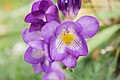 Mauve-colored freesia cultivar
 -
 Freesia verrucosa
 -
 Freesia viridis in Curtis's Botanical Magazine, Volume 31: t. 1275, as Tritonia viridis
 -
 Freesia viridis subsp. crispifolia
_Klatt_(AM_AK333551-2).jpg)


References
- ^ a b c d e Search for "Freesia", World Checklist of Selected Plant Families, Royal Botanic Gardens, Kew, retrieved 2012-08-13
- ^ Manning, John; Goldblatt, Peter (2008). The Iris Family: Natural History & Classification. Portland, Oregon: Timber Press. pp. 149–52. ISBN 978-0-88192-897-6.
- ^ Dutch flowerpaper, Bloemenkrant, publisher Verhagen, week 12-2015, see also http://issuu.com/twovisions/docs/bk_week_12_15?e=1360358/11894263
- ^ Mathew, Brian (1987), The Smaller Bulbs, London: B.T. Batsford, ISBN 978-0-7134-4922-8, p. 9
- ^ Innes, Clive (1985), The World of Iridaceae, Ashington, UK: Holly Gate International, ISBN 978-0-948236-01-3, p. 18
Bibliography
- Manning, John C.; Goldblatt, Peter (2010). Botany and horticulture of the genus Freesia (Iridaceae). Strelitzia vol. 27. Pretoria: South African National Biodiversity Institute, SANBI. ISBN 978-1-919976-58-7.
- Goldblatt, P. (1982) Systematics of Freesia Klatt (Iridaceae) J. South African Bot. 48:39-93.
External links

- Chisholm, Hugh, ed. (1911). . Encyclopædia Britannica (11th ed.). Cambridge University Press.
- Freesias photos of International Bulb Society
- Freesias photos of Pacific Bulb Society
- PlantZAfrica: Freesia
- Freesia info and pictures Archived 2011-04-30 at the Wayback Machine (in Spanish)
- How to grow freesia in warm climates
| National | |
|---|---|
| Other | |

Content Disclaimer
Informasi ini disarikan dari Wikipedia dan disajikan kembali untuk tujuan edukasi. Konten tersedia di bawah lisensi CC BY-SA 3.0. Kami tidak bertanggung jawab atas ketidakakuratan data yang bersumber dari kontribusi publik tersebut.
- The information displayed on this website is sourced in part or in whole from Wikipedia and has been adapted for the purpose of restating it. We strive to provide accurate and relevant information, however:
- There is no guarantee of absolute accuracy. Wikipedia is an open, collaborative project that can be edited by anyone, so information is subject to change.
- It is not intended to constitute professional advice. The content displayed is for informational and educational purposes only. For important decisions (e.g., medical, legal, or financial), please consult a professional.
- Content copyright. Wikipedia is licensed under the Creative Commons Attribution-ShareAlike License (CC BY-SA). This means that content may be reused with appropriate attribution and shared under a similar license.
- Responsible use. Any risk arising from the use of information from this website is entirely the responsibility of the user.