Fractional programming
In mathematical optimization, fractional programming is a generalization of linear-fractional programming. The objective function in a fractional program is a ratio of two functions that are in general nonlinear. The ratio to be optimized often describes some kind of efficiency of a system.
Definition
Let be real-valued functions defined on a set . Let . The nonlinear program



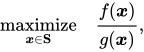
where on , is called a fractional program.


Concave fractional programs
A fractional program in which f is nonnegative and concave, g is positive and convex, and S is a convex set is called a concave fractional program. If g is affine, f does not have to be restricted in sign. The linear fractional program is a special case of a concave fractional program where all functions are affine.
Properties
The function is semistrictly quasiconcave on S. If f and g are differentiable, then q is pseudoconcave. In a linear fractional program, the objective function is pseudolinear.

Transformation to a concave program
By the transformation , any concave fractional program can be transformed to the equivalent parameter-free concave program[1]
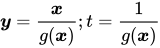
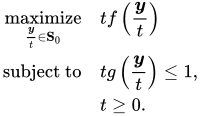
If g is affine, the first constraint is changed to and the assumption that g is positive may be dropped. Also, it simplifies to .


Duality
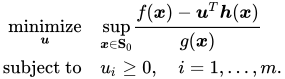
The Lagrangian dual of the equivalent concave program is
Notes
References
- Avriel, Mordecai; Diewert, Walter E.; Schaible, Siegfried; Zang, Israel (1988). Generalized Concavity. Plenum Press.
- Schaible, Siegfried (1983). "Fractional programming". Zeitschrift für Operations Research. 27: 39–54. doi:10.1007/bf01916898. S2CID 28766871.
Content Disclaimer
Informasi ini disarikan dari Wikipedia dan disajikan kembali untuk tujuan edukasi. Konten tersedia di bawah lisensi CC BY-SA 3.0. Kami tidak bertanggung jawab atas ketidakakuratan data yang bersumber dari kontribusi publik tersebut.
- The information displayed on this website is sourced in part or in whole from Wikipedia and has been adapted for the purpose of restating it. We strive to provide accurate and relevant information, however:
- There is no guarantee of absolute accuracy. Wikipedia is an open, collaborative project that can be edited by anyone, so information is subject to change.
- It is not intended to constitute professional advice. The content displayed is for informational and educational purposes only. For important decisions (e.g., medical, legal, or financial), please consult a professional.
- Content copyright. Wikipedia is licensed under the Creative Commons Attribution-ShareAlike License (CC BY-SA). This means that content may be reused with appropriate attribution and shared under a similar license.
- Responsible use. Any risk arising from the use of information from this website is entirely the responsibility of the user.