Feferman–Vaught theorem
The Feferman–Vaught theorem[1] in model theory is a theorem by Solomon Feferman and Robert Lawson Vaught that shows how to reduce, in an algorithmic way, the first-order theory of a product of structures to the first-order theory of elements of the structure.
The theorem is considered to be one of the standard results in model theory.[2][3][4] The theorem extends the previous result of Andrzej Mostowski on direct products of theories.[5] It generalizes (to formulas with arbitrary quantifiers) the property in universal algebra that equalities (identities) carry over to direct products of algebraic structures (which is a consequence of one direction of Birkhoff's theorem).
Direct product of structures
Consider a first-order logic signature L. The definition of product structures takes a family of L-structures for for some index set I and defines the product structure , which is also an L-structure, with all functions and relations defined pointwise.


The definition generalizes the direct product in universal algebra to structures for languages that contain not only function symbols but also relation symbols.
If is a relation symbol with arguments in L and are elements of the cartesian product, we define the interpretation of in by
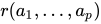





When is a functional relation, this definition reduces to the definition of direct product in universal algebra.
Statement of the theorem for direct products
For a first-order formula in signature L with free variables a subset of , and for an interpretation of the variables , we define the set of indices for which holds in



Given a first-order formula with free variables , there is an algorithm to compute its equivalent game normal form, which is a finite disjunction of mutually contradictory formulas.

The Feferman–Vaught theorem gives an algorithm that takes a first-order formula and constructs a formula that reduces the condition that holds in the product to the condition that holds in the interpretation of sets of indices:


The formula is thus a formula with free set variables, for example, in the first-order theory of fields of sets.
Proof idea
The formula can be constructed following the structure of the starting formula . When is quantifier free then, by definition of direct product above it follows

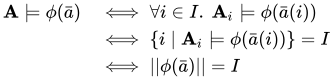
Consequently, we can take to be the equality in the language of fields of sets.


Extending the condition to quantified formulas can be viewed as a form of quantifier elimination, where quantification over product elements in is reduced to quantification over subsets of .

Generalized products
It is often of interest to consider substructure of the direct product structure. If the restriction that defines product elements that belong to the substructure can be expressed as a condition on the sets of index elements, then the results can be generalized.
An example is the substructure of product elements that are constant at all but finitely many indices. Assume that the language L contains a constant symbol and consider the substructure containing only those product elements for which the set



is finite. The theorem then reduces the truth value in such substructure to a formula in the field of sets, where certain sets are restricted to be finite.
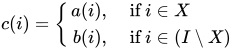
One way to define generalized products is to consider those substructures where the sets belong to some field of sets of indices (a subset of the powerset set algebra ), and where the product substructure admits gluing.[6] Here admitting gluing refers to the following closure condition: if are two product elements and is the element of the field of sets, then so is the element defined by "gluing" and according to :


Consequences
The Feferman–Vaught theorem implies the decidability of Skolem arithmetic by viewing, via the fundamental theorem of arithmetic, the structure of natural numbers with multiplication as a generalized product (power) of Presburger arithmetic structures.
Given an ultrafilter on the set of indices , we can define a quotient structure on product elements, leading to the theorem of Jerzy Łoś that can be used to construct hyperreal numbers.
Notes
- ^ Feferman & Vaught 1959.
- ^ Hodges 1993, Section 9.6: Feferman-Vaught theorem.
- ^ Karp 1959.
- ^ Monk 1976, Chapter 23: Generalized Products.
- ^ Mostowski 1952.
- ^ Hodges 1993, p. 459, Section 9.6: Feferman-Vaught theorem.
References
- Feferman, S.; Vaught, R. (1959). "The first order properties of products of algebraic systems". Fundamenta Mathematicae. 47 (1): 57–103. doi:10.4064/fm-47-1-57-103.
- Hodges, Wilfrid (1993). Model theory. Cambridge University Press. ISBN 0521304423. LCCN 91-25082.
- Karp, Carol (1959). "S. Feferman and R. L. Vaught. The first order properties of products of algebraic systems". Fundamenta Mathematicae. 47: 57–103. doi:10.4064/fm-47-1-57-103.[1]
- Monk, J. Donald (1976). "23: Generalized Products". Mathematical Logic. Graduate Texts in Mathematics. Berlin, New York: Springer-Verlag. ISBN 978-0-387-90170-1.
- Mostowski, Andrzej (March 1952). "On direct products of theories". Journal of Symbolic Logic. 17 (1): 1–31. doi:10.2307/2267454. JSTOR 2267454.
Major mathematics areas | |
|---|---|
| Foundations | |
| Algebra | |
| Analysis | |
| Discrete | |
| Geometry | |
| Number theory | |
| Topology | |
| Applied | |
| Computational | |
| Related topics | |


| General | |||||||||
|---|---|---|---|---|---|---|---|---|---|
| Theorems (list), paradoxes | |||||||||
| Logics |
| ||||||||
| Set theory |
| ||||||||
| Formal systems (list), language, syntax |
| ||||||||
| Proof theory | |||||||||
| Model theory | |||||||||
| Computability theory | |||||||||
| Related | |||||||||
- ^ "Review". Journal of Symbolic Logic. 32 (2): 276. August 1967. doi:10.2307/2271704. JSTOR 2271704.
Content Disclaimer
Informasi ini disarikan dari Wikipedia dan disajikan kembali untuk tujuan edukasi. Konten tersedia di bawah lisensi CC BY-SA 3.0. Kami tidak bertanggung jawab atas ketidakakuratan data yang bersumber dari kontribusi publik tersebut.
- The information displayed on this website is sourced in part or in whole from Wikipedia and has been adapted for the purpose of restating it. We strive to provide accurate and relevant information, however:
- There is no guarantee of absolute accuracy. Wikipedia is an open, collaborative project that can be edited by anyone, so information is subject to change.
- It is not intended to constitute professional advice. The content displayed is for informational and educational purposes only. For important decisions (e.g., medical, legal, or financial), please consult a professional.
- Content copyright. Wikipedia is licensed under the Creative Commons Attribution-ShareAlike License (CC BY-SA). This means that content may be reused with appropriate attribution and shared under a similar license.
- Responsible use. Any risk arising from the use of information from this website is entirely the responsibility of the user.