Expenditure minimization problem
In microeconomics, the expenditure minimization problem is the dual of the utility maximization problem: "how much money do I need to reach a certain level of happiness?". This question comes in two parts. Given a consumer's utility function, prices, and a utility target,
- how much money would the consumer need? This is answered by the expenditure function.
- what could the consumer buy to meet this utility target while minimizing expenditure? This is answered by the Hicksian demand function.
Expenditure function
Formally, the expenditure function is defined as follows. Suppose the consumer has a utility function defined on commodities. Then the consumer's expenditure function gives the amount of money required to buy a package of commodities at given prices that give utility of at least ,


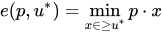
where

is the set of all packages that give utility at least as good as .
Hicksian demand correspondence
Hicksian demand is defined by
- .[1]

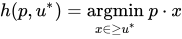
Hicksian demand function gives the cheapest package that gives the desired utility. It is related to Marshallian demand function by and expenditure function by

The relationship between the utility function and Marshallian demand in the utility maximization problem mirrors the relationship between the expenditure function and Hicksian demand in the expenditure minimization problem. It is also possible that the Hicksian and Marshallian demands are not unique (i.e. there is more than one commodity bundle that satisfies the expenditure minimization problem); then the demand is a correspondence, and not a function. This does not happen, and the demands are functions, under the assumption of local nonsatiation.
See also
References
- ^ Jonathan Levin; Paul Milgrom. "Consumer Theory" (PDF).
- Mas-Colell, Andreu; Whinston, Michael & Green, Jerry (1995). Microeconomic Theory. Oxford: Oxford University Press. ISBN 0-19-507340-1.
External links
Content Disclaimer
Informasi ini disarikan dari Wikipedia dan disajikan kembali untuk tujuan edukasi. Konten tersedia di bawah lisensi CC BY-SA 3.0. Kami tidak bertanggung jawab atas ketidakakuratan data yang bersumber dari kontribusi publik tersebut.
- The information displayed on this website is sourced in part or in whole from Wikipedia and has been adapted for the purpose of restating it. We strive to provide accurate and relevant information, however:
- There is no guarantee of absolute accuracy. Wikipedia is an open, collaborative project that can be edited by anyone, so information is subject to change.
- It is not intended to constitute professional advice. The content displayed is for informational and educational purposes only. For important decisions (e.g., medical, legal, or financial), please consult a professional.
- Content copyright. Wikipedia is licensed under the Creative Commons Attribution-ShareAlike License (CC BY-SA). This means that content may be reused with appropriate attribution and shared under a similar license.
- Responsible use. Any risk arising from the use of information from this website is entirely the responsibility of the user.