Equivalent airspeed
 | This article needs additional citations for verification. (January 2009) |
In aviation, equivalent airspeed (EAS) is calibrated airspeed (CAS) corrected for the compressibility of air at a non-trivial Mach number. It is also the airspeed at sea level in the International Standard Atmosphere at which the dynamic pressure is the same as the dynamic pressure at the true airspeed (TAS) and altitude at which the aircraft is flying.[1][2] In low-speed flight, it is the speed which would be shown by an airspeed indicator with zero error.[3] It is useful for predicting aircraft handling, aerodynamic loads, stalling etc.
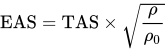
where ρ is actual air density and ρ0 is standard sea level density (1.225 kg/m3 or 0.00237 slug/ft3).
EAS is a function of dynamic pressure:
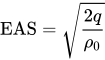
where q is the dynamic pressure

EAS can also be obtained from the aircraft Mach number and static pressure.
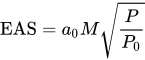
where a0 is 1,225 km/h (661.45 kn) (the standard speed of sound at 15 °C), M is the Mach number, P is static pressure, and P0 is standard sea level pressure (1013.25 hPa).
Combining the above with the expression for Mach number gives EAS as a function of impact pressure and static pressure (valid for subsonic flow):
![{\displaystyle \mathrm {EAS} =a_{0}{\sqrt {{\frac {5P}{P_{0}}}\left[\left({\frac {q_{c}}{P}}+1\right)^{\frac {2}{7}}-1\right]}}}](https://wikimedia.org/api/rest_v1/media/math/render/svg/f70f5b0541ec94cd58a4c5a68402d5062d8b3329)
where qc is impact pressure.
At standard sea level, EAS is the same as calibrated airspeed (CAS) and true airspeed (TAS). At any other altitude, EAS may be obtained from CAS by correcting for compressibility error.
The following simplified formula allows calculation of CAS from EAS:
![{\displaystyle \mathrm {CAS} ={\mathrm {EAS} \times \left[1+{\frac {1}{8}}(1-\delta )M^{2}+{\frac {3}{640}}(1-10\delta +9\delta ^{2})M^{4}\right]}}](https://wikimedia.org/api/rest_v1/media/math/render/svg/cc7aae81800c693e13694d09882b1fb2cd5d71e6)
where the pressure ratio and CAS, EAS are airspeeds and can be measured in knots, km/h, mph or any other appropriate unit.

The above formula is accurate within 1% up to Mach 1.2 and useful with acceptable error up to Mach 1.5. The 4th order Mach term can be neglected for speeds below Mach 0.85.
See also
References
- ^ Clancy, L.J. (1975), Aerodynamics, Section 3.8, Pitman Publishing Limited, London. ISBN 0-273-01120-0
- ^ Anderson, John D. (2007), Fundamentals of Aerodynamics, p.215 (4th edition), McGraw-Hill, New York USA. ISBN 978-0-07-295046-5
- ^ Houghton, E.L. and Carpenter, P.W. (1993), Aerodynamics for Engineering Students, Section 2.3.3, Butterworth-Heinemann, Oxford UK. ISBN 0-340-54847-9
Bibliography
- Anderson, John D. (2007), Fundamentals of Aerodynamics, Section 3.4 (4th edition), McGraw-Hill, New York USA. ISBN 978-0-07-295046-5
- Gracey, William (1980), "Measurement of Aircraft Speed and Altitude" Archived 2021-09-26 at the Wayback Machine (11 MB), NASA Reference Publication 1046.
External links
Content Disclaimer
Informasi ini disarikan dari Wikipedia dan disajikan kembali untuk tujuan edukasi. Konten tersedia di bawah lisensi CC BY-SA 3.0. Kami tidak bertanggung jawab atas ketidakakuratan data yang bersumber dari kontribusi publik tersebut.
- The information displayed on this website is sourced in part or in whole from Wikipedia and has been adapted for the purpose of restating it. We strive to provide accurate and relevant information, however:
- There is no guarantee of absolute accuracy. Wikipedia is an open, collaborative project that can be edited by anyone, so information is subject to change.
- It is not intended to constitute professional advice. The content displayed is for informational and educational purposes only. For important decisions (e.g., medical, legal, or financial), please consult a professional.
- Content copyright. Wikipedia is licensed under the Creative Commons Attribution-ShareAlike License (CC BY-SA). This means that content may be reused with appropriate attribution and shared under a similar license.
- Responsible use. Any risk arising from the use of information from this website is entirely the responsibility of the user.