E-function
In mathematics, E-functions are a type of power series that satisfy particular arithmetic conditions on the coefficients. They are of interest in transcendental number theory, and are closely related to G-functions.
Definition
A power series with coefficients in the field of algebraic numbers
![{\displaystyle f(x)=\sum _{n=0}^{\infty }c_{n}{\frac {x^{n}}{n!}}\in {\overline {\mathbb {Q} }}[\![x]\!]}](https://wikimedia.org/api/rest_v1/media/math/render/svg/7211bfa6ee051372368e9139f805ef0edac9dc35)
is called an E-function[1] if it satisfies the following three conditions:
- It is a solution of a non-zero linear differential equation with polynomial coefficients (this implies that all the coefficients cn belong to the same algebraic number field, K, which has finite degree over the rational numbers);
- For all ,

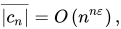
- where the left hand side represents the maximum of the absolute values of all the algebraic conjugates of cn;
- For all there is a sequence of natural numbers q0, q1, q2,... such that qnck is an algebraic integer in K for k = 0, 1, 2,..., n, and n = 0, 1, 2,... and for which
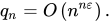
The second condition implies that f is an entire function of x.
Uses
E-functions were first studied by Siegel in 1929.[2] He found a method to show that the values taken by certain E-functions were algebraically independent. This was a result which established the algebraic independence of classes of numbers rather than just linear independence.[3] Since then these functions have proved somewhat useful in number theory and in particular they have application in transcendence proofs and differential equations.[4]
The Siegel–Shidlovsky theorem
Perhaps the main result connected to E-functions is the Siegel–Shidlovsky theorem (also known as the Siegel and Shidlovsky theorem), named after Carl Ludwig Siegel and Andrei Borisovich Shidlovsky.
Suppose that we are given n E-functions, E1(x),...,En(x), that satisfy a system of homogeneous linear differential equations
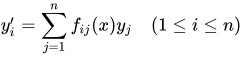
where the fij are rational functions of x, and the coefficients of each E and f are elements of an algebraic number field K. Then the theorem states that if E1(x),...,En(x) are algebraically independent over K(x), then for any non-zero algebraic number α that is not a pole of any of the fij the numbers E1(α),...,En(α) are algebraically independent.
Examples
- Any polynomial with algebraic coefficients is a simple example of an E-function.
- The exponential function is an E-function, in its case cn = 1 for all of the n.
- If λ is an algebraic number then the Bessel function Jλ is an E-function.
- The sum or product of two E-functions is an E-function. In particular E-functions form a ring.
- If a is an algebraic number and f(x) is an E-function then f(ax) will be an E-function.
- If f(x) is an E-function then the derivative and integral of f are also E-functions.
References
- ^ Carl Ludwig Siegel, Transcendental Numbers, p.33, Princeton University Press, 1949.
- ^ C.L. Siegel, Über einige Anwendungen diophantischer Approximationen, Abh. Preuss. Akad. Wiss. 1, 1929.
- ^ Alan Baker, Transcendental Number Theory, pp.109-112, Cambridge University Press, 1975.
- ^ Serge Lang, Introduction to Transcendental Numbers, pp.76-77, Addison-Wesley Publishing Company, 1966.
Content Disclaimer
Informasi ini disarikan dari Wikipedia dan disajikan kembali untuk tujuan edukasi. Konten tersedia di bawah lisensi CC BY-SA 3.0. Kami tidak bertanggung jawab atas ketidakakuratan data yang bersumber dari kontribusi publik tersebut.
- The information displayed on this website is sourced in part or in whole from Wikipedia and has been adapted for the purpose of restating it. We strive to provide accurate and relevant information, however:
- There is no guarantee of absolute accuracy. Wikipedia is an open, collaborative project that can be edited by anyone, so information is subject to change.
- It is not intended to constitute professional advice. The content displayed is for informational and educational purposes only. For important decisions (e.g., medical, legal, or financial), please consult a professional.
- Content copyright. Wikipedia is licensed under the Creative Commons Attribution-ShareAlike License (CC BY-SA). This means that content may be reused with appropriate attribution and shared under a similar license.
- Responsible use. Any risk arising from the use of information from this website is entirely the responsibility of the user.