Dynamic method
The dynamic method is a procedure for the determination of the masses of asteroids. The procedure gets its name from its use of the Newtonian laws of the dynamics, or motion, of asteroids as they move around the Solar System. The procedure works by taking multiple position measurements to determine the gravitational deflection caused when two or more asteroids move past each other. The method relies on the fact that the large number of known asteroids means they will occasionally move past one another at very close distances. If at least one of the two interacting bodies is large enough, its gravitational influence on the other can reveal its mass. The accuracy of the determined mass is limited by the precision and timing of the appropriate astrometric observations being made to determine the gravitational deflection caused by a given interaction.[1]
Because the method relies on detecting the amount of gravitational deflection induced during an interaction, the procedure works best for objects which will produce a large deflection in their interactions with other objects. This means that the procedure works best for large objects, but it can also be effectively applied to objects which have repeated close interactions with each other such as when the two objects are in orbital resonance with one another. Regardless of the mass of the interacting objects, the amount of deflection will be greater if the objects approach nearer to each other and it will also be greater if the objects pass slowly, allowing more time for gravity to perturb the orbits of the two objects. For large enough asteroids this distance can be as large as ~0.1 AU, for less massive asteroids the conditions of the interaction would need to be correspondingly better.[1]
Mathematical analysis
The simplest way to describe the deflection of the asteroids is in the case where one object is significantly more massive than the other. In this case the equations of motion are the same as for that of Rutherford scattering between oppositely charged objects (so that the force is attractive rather than repulsive). When rewritten in the more familiar notation used in celestial mechanics deflection angle can be related to the eccentricity of the hyperbolic orbit of the smaller object relative to the larger one by the following formula:[2]
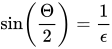
Here is the angle between the asymptotes of the hyperbolic orbit of the small object relative to the large one, and is the eccentricity of this orbit (which must be greater than 1 for a hyperbolic orbit).


A more sophisticated description using matrices can be achieved by separating the observed objects position on the sky as a function of time into the sum of two components: one which is a result of the relative motion of the objects themselves, and the other the motion induced by the gravitational influence of the two bodies. The relative contributions of the two terms in the best fit of this equation onto the actual observations of the objects yields the objects masses.
References
- ^ a b Kochetova, O.M. (2004). "Determination of Large Asteroid Masses by the Dynamical Method". Solar System Research. 38 (1): 66–75. Bibcode:2004SoSyR..38...66K. doi:10.1023/B:SOLS.0000015157.65020.84. S2CID 121459899.
- ^ Barger, Vernon D.; Olsson, Martin G. (1995). "5.6". Classical Mechanics: A Modern Perspective (2nd. ed.). McGraw-Hill. ISBN 0-07-003734-5.
| Main | |||||||||
|---|---|---|---|---|---|---|---|---|---|
| Distribution |
| ||||||||
| Classification |
| ||||||||
| Exploration | |||||||||
| Lists | |||||||||
| Related | |||||||||

Content Disclaimer
Informasi ini disarikan dari Wikipedia dan disajikan kembali untuk tujuan edukasi. Konten tersedia di bawah lisensi CC BY-SA 3.0. Kami tidak bertanggung jawab atas ketidakakuratan data yang bersumber dari kontribusi publik tersebut.
- The information displayed on this website is sourced in part or in whole from Wikipedia and has been adapted for the purpose of restating it. We strive to provide accurate and relevant information, however:
- There is no guarantee of absolute accuracy. Wikipedia is an open, collaborative project that can be edited by anyone, so information is subject to change.
- It is not intended to constitute professional advice. The content displayed is for informational and educational purposes only. For important decisions (e.g., medical, legal, or financial), please consult a professional.
- Content copyright. Wikipedia is licensed under the Creative Commons Attribution-ShareAlike License (CC BY-SA). This means that content may be reused with appropriate attribution and shared under a similar license.
- Responsible use. Any risk arising from the use of information from this website is entirely the responsibility of the user.