Draft:Normal cone (variational analysis)
 | Review waiting, please be patient.
This may take 3 months or more, since drafts are reviewed in no specific order. There are 4,511 pending submissions waiting for review.
Where to get help
How to improve a draft
You can also browse Wikipedia:Featured articles and Wikipedia:Good articles to find examples of Wikipedia's best writing on topics similar to your proposed article. Improving your odds of a speedy review To improve your odds of a faster review, tag your draft with relevant WikiProject tags using the button below. This will let reviewers know a new draft has been submitted in their area of interest. For instance, if you wrote about a female astronomer, you would want to add the Biography, Astronomy, and Women scientists tags. Editor resources
Reviewer tools
|
In variational analysis, set-valued analysis and optimization, the concept of a normal cone to a subset of a space generalizes that of the orthogonal complement / annihilator of a vector space, (outward) normal vector fields to surfaces — or more generally of the normal bundle of an embedded submanifold — to possibly non-smooth subsets of vector spaces.
Normal cones provide, among other things, the geometrical foundation for generalizing the convex subdifferential to non-convex functions. Of particular note is also their role in generalizing Fermat's rule to give necessary (and sometimes also sufficient) first order optimality conditions for constrained and non-smooth optimization problems. Moreover they play a role in defining coderivatives of set-valued maps. [1]
In the non-convex case there are several inequivalent definitions for a normal cone that all turn out to be useful and interesting for different problems — whereas in the convex case these all coincide which greatly simplifies things. For clarity and approachability this article first discusses the convex case over Hilbert spaces before going into the non-convex case over more general spaces.
Conventions
All vector spaces in this article are assumed to be real. The set denotes the extended real numbers and a function is called proper if it is nowhere equal to and also somewhere finite. We also assume that all cones contain zero. Sums of sets throughout the article are to be interpreted as Minkowski sums.


Convex Case
Definition
The convex normal cone to a non-empty convex subset of a (pre-)Hilbert space is defined byfor all , and for all . [2][3] Here denotes the inner product of .


Geometric Interpretation
This definition can intuitively be understood as follows: suppose and , then is the vector from to . If then would be orthogonal to , while the condition additionally allows to "point away" from more than 90°. So the (convex) normal cone at is the set of all vectors that point at least 90° away from all the vectors from to ; but translated to the origin.


Examples
- When is a subspace of , then is the linear-algebraic normal space / orthogonal complement to for . If is instead an affine subspace then is instead the orthogonal complement to the underlying parallel vector space of .
- Let be a non-empty, closed, convex set and consider its convex indicator function Then
- For a proper, lower-semicontinuous, convex function we have , where denotes the epigraph of and the convex subdifferential of . This relationship serves to define further subdifferentials based on normal cones in the non-convex case.


Properties
- is a non-empty, convex cone for all .
- If , then .[3] The forward direction holds even if is infinite dimensional, while the backward direction may fail unless has nonempty interior.[4]
- Let be non-empty, closed, convex. Then , where is the metric projection of onto . [3]
- Intersection Rule: for any two nonempty, convex subsets of a tvs and . Provided that the qualification condition holds, the reverse inclusion is also true such that The qualification condition may be further weakened, especially if is a nicer space. [4] For example if is Banach and the two convex sets are closed, it is sufficient that , while in finite dimensions one can show that for any finite family of convex sets whose relative interiors intersect.
- For further calculus rules cf. the properties of the non-convex generalizations below.


Another very important property is what is sometimes called Fermat's rule: let be convex, nonempty, closed and convex. Then, assuming some very mild constraint qualifications (c.f. for example Proposition 27.8 in [3]), solves the constrained minimization problem if and only if . If is differentiable this reduces to (here is the Fréchet gradient of ; i.e. the pointwise Riesz representative of the Fréchet derivative of ).


Generalization
More generally, one may define for any topological vector space , with topological dual . In this case is the duality pairing of and In this more general setting the normal cone can be recognized to be the set of all that attain their maximum on at . [1] This connects normal cones to another important class of objects, the so-called support function of a set. One has .


Non-Convex Case
In the remainder of this article we will assume the space we're working on to be Asplund for ease of exposition. While some of the following definitions and properties are fine / remain true for more general spaces (e.g. general normed spaces), this is not true for all of them. The class of Asplund spaces contains many important Banach spaces, for example all -spaces for , but not the cases


Definition
Let be an Asplund space with topological dual and a (potentially non-convex) nonempty subset of . There are three main normal cones defined for this case:

- The Fréchet normal cone is defined by for any , and empty outside of that. Alternatively it may be defined as the polar of the Bouligand tangent cone [1]. Note that these definitions generally only coincide if is closed. Alternatively one may define where denotes a "small-o" Landau symbol; this in turn is equivalent to the first definition[5].
- The Mordukhovich (or limiting) normal cone is defined by Here is an outer limit of sets where X carries its usual norm topology while is endowed with its weak* topology and the notation means that " converges to along ", i.e. the sequence of points in the definition of the outer limit is a sequence of points in .
- The Clarke normal cone is defined by where is the topological closure and the convex hull of a set.


These normal cones form a nested hierarchy .

Alternate names and notation
The Fréchet normal cone is also called the firm, regular and prenormal Normal cone in the literature and often times denoted by The Mordukhovich normal cone is also called the limiting or basic normal cone and sometimes denoted by or . The Clarke normal cone is also called the convexified normal cone and sometimes denoted by [5][6][7]


Comparison of Fréchet, Mordukhovich and Clarke normal cones for applications to optimization
Suppose, for simplicity, that we have some Fréchet differentiable function and consider the stationarity condition corresponding to each of the three normal cones. If is "too large" — in the extreme case we may even find that — we can't expect these conditions to actually tell us anything about the (non-)optimality of . Conversely, if is "too small" — in the extreme case we might find it to be empty or to only contain zero — we will find it difficult or even impossible to verify that , or to computationally determine such that this holds. Because of this (and differences in their associated calculi) all three cones (as well as further ones) have their place in the theory and applications.


Examples
- Let . Then, identifying , we have , and
- Suppose is a smooth embedded submanifold. Let and denote by the normal space of at . Then .[5]


![{\displaystyle N_{A}^{F}(0)=\{0\}\times (-\infty ,0]}](https://wikimedia.org/api/rest_v1/media/math/render/svg/9ac8364a4d928a78bd5aad82749dd1a6ffc34641)


Properties
- The inclusions always hold, in general they are strict.
- may be trivial, while is always nontrivial provided that , is closed and .
- Since the Clarke normal cone is always convex it can often end up being "too large" in practice and may degenerate to . In contrast to this, the Mordukhovich normal cone can be nonconvex which allows it to remain "small enough to be useful" in some cases where Clarke is too large.
- It holds that where is the prepolar of a set and is the polar of a set so that is the bipolar of .


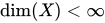


- Let be a convex set, then .
- is stable, that is
- Let be Hilbert, non-empty and closed, and suppose . Then . (Note that in contrast to the convex case this fails to be an equivalence in general. Moreover, if is infinite dimensional there may be no such )
- Product Rule: for any two nonempty, closed subsets , of a normed space . The analogous statement holds for . [1]
- Intersection rule: Suppose is a finite family of closed subsets in that is allied at . Thenholds. Alliedness is a somewhat lengthy, technical condition that may be found in Penot's book. Alternatively one may assume the so-called Fuzzy qualification condition. [1]
- Chain Rule: Let be a -function, and where are closed in respectively. Then subject to some constraint qualifications and regularity conditions. [5] Here is the Jacobian of .





References
- ^ a b c d e Penot, Jean-Paul (2013). Calculus Without Derivatives. Graduate Texts in Mathematics. Vol. 266. New York, NY: Springer New York. doi:10.1007/978-1-4614-4538-8. ISBN 978-1-4614-4537-1.
- ^ Rockafellar, Ralph Tyrell (2015). Convex Analysis. Princeton Landmarks in Mathematics and Physics. Princeton: Princeton University Press. ISBN 978-0-691-01586-6.
- ^ a b c d Bauschke, Heinz H.; Combettes, Patrick L. (2017). Convex Analysis and Monotone Operator Theory in Hilbert Spaces. CMS Books in Mathematics. Cham: Springer International Publishing. doi:10.1007/978-3-319-48311-5. ISBN 978-3-319-48310-8.
- ^ a b Mordukhovich, Boris S.; Mau Nam, Nguyen (2022). Convex Analysis and Beyond: Volume I: Basic Theory. Springer Series in Operations Research and Financial Engineering. Cham: Springer International Publishing. doi:10.1007/978-3-030-94785-9. ISBN 978-3-030-94784-2.
- ^ a b c d Rockafellar, R. Tyrrell; Wets, Roger J. B. (1998). Variational Analysis. Grundlehren der mathematischen Wissenschaften. Vol. 317. Berlin, Heidelberg: Springer Berlin Heidelberg. doi:10.1007/978-3-642-02431-3. ISBN 978-3-540-62772-2.
- ^ Mordukhovich, Boris S. (2024). Second-Order Variational Analysis in Optimization, Variational Stability, and Control: Theory, Algorithms, Applications. Springer Series in Operations Research and Financial Engineering. Cham: Springer International Publishing. doi:10.1007/978-3-031-53476-8. ISBN 978-3-031-53475-1.
- ^ Clarke, Francis (2013). Functional Analysis, Calculus of Variations and Optimal Control. Graduate Texts in Mathematics. Vol. 264. London: Springer London. doi:10.1007/978-1-4471-4820-3. ISBN 978-1-4471-4819-7.
Content Disclaimer
Informasi ini disarikan dari Wikipedia dan disajikan kembali untuk tujuan edukasi. Konten tersedia di bawah lisensi CC BY-SA 3.0. Kami tidak bertanggung jawab atas ketidakakuratan data yang bersumber dari kontribusi publik tersebut.
- The information displayed on this website is sourced in part or in whole from Wikipedia and has been adapted for the purpose of restating it. We strive to provide accurate and relevant information, however:
- There is no guarantee of absolute accuracy. Wikipedia is an open, collaborative project that can be edited by anyone, so information is subject to change.
- It is not intended to constitute professional advice. The content displayed is for informational and educational purposes only. For important decisions (e.g., medical, legal, or financial), please consult a professional.
- Content copyright. Wikipedia is licensed under the Creative Commons Attribution-ShareAlike License (CC BY-SA). This means that content may be reused with appropriate attribution and shared under a similar license.
- Responsible use. Any risk arising from the use of information from this website is entirely the responsibility of the user.