This may take 3 months or more, since drafts are reviewed in no specific order. There are 4,441 pending submissions waiting for review.
If the submission is accepted, then this page will be moved into the article space.
If the submission is declined, then the reason will be posted here.
In the meantime, you can continue to improve this submission by editing normally.
Where to get help
If you need help editing or submitting your draft, please ask us a question at the AfC Help Desk or get live help from experienced editors. These venues are only for help with editing and the submission process, not to get reviews.
If you need feedback on your draft, or if the review is taking a lot of time, you can try asking for help on the talk page of a relevant WikiProject. Some WikiProjects are more active than others so a speedy reply is not guaranteed.
To improve your odds of a faster review, tag your draft with relevant WikiProject tags using the button below. This will let reviewers know a new draft has been submitted in their area of interest. For instance, if you wrote about a female astronomer, you would want to add the Biography, Astronomy, and Women scientists tags.
In functional analysis, the multiple operator integral is a multilinear map determined by linear operators and a multivariable function that lives on the product of the spectra of .
Multiple operator integrals are of use in various situations where functional calculus appears alongside noncommuting operators (such as matrices or differential operators), for instance in perturbation theory, harmonic analysis, index theory, noncommutative geometry, and operator theory in general. As noncommuting operators, functional calculus, and perturbation theory are central to quantum theory, multiple operator integrals are also frequently applied there. Closely related concepts are Schur multiplication and the Feynman operational calculus. Multiple operator integrals in their modern form were introduced by Peller.[1] They are multilinear generalizations of double operator integrals, developed by Daletski, Krein, Birman, and Solomyak, among others.
Definition
A conceptually clean definition of the multiple operator integral is given as follows. Let , let be a separable Hilbert space, and denote the space of bounded operators by . Let be possibly unbounded self-adjoint operators in .
For any function (called the symbol) which admits a decomposition
for a certain finite measure space and bounded measurable functions , the multiple operator integral is the -multilinear operator
defined by
for all . One can show that the integrand is Bochner integrable, and (using Banach-Steinhaus) that is a bounded multilinear map. Moreover, only depends on and through , as the notation suggests.
Other definitions
One may similarly define on the product of Schatten classes and end up with a mapping
where . The restriction of the domain allows the multiple operator integral to be defined for a larger class of symbols .
Because one can (and often needs to) trade of assumptions on , , and , there are several definitions of the multiple operator integral which are not generalizations of one another, but typically agree in the cases where both are defined. In a way all definitions are ways to make precise the formal expression
The multiple operator integral can also be defined[2] on the product of noncommutative -spaces as
for a von Neumann algebra admitting a semifinite trace . One then additionally assumes that are affiliated to .
Divided differences
The most often used symbol of a multiple operator integral is the divided difference of an times continuously differentiable function , defined recursively as
It follows that for any permutation , , and, for ,
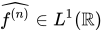
The multiple operator integral is known to exist in the case that in a suitable Besov space, for example, when , and the multiple operator integral for Hölder conjugate (as above), is known to exist when with bounded.
Properties
The fact that does not depend on the integral representation of allows one to deduce MOI-identities from the respective identities of the symbols. For example, implies (the right-hand side moreover equals by definition of the MOI).
One can thus derive operator-theoretic formulas from elementary computations with scalar-valued functions, similar to (but more general than) using the integral kernel of an integral operator, as ubiquitous in quantum field theory. This technique in particular yields useful identities when working with divided differences as symbols.
Algebraic properties
The double operator integral has the following properties:
Using the fact that the multiple operator integral of zero order is simply functional calculus:
one recognizes that 1. and 2. are identities relating multiple operator integrals of 0 order (single operator integrals) to multiple operator integrals of 1st order (double operator integrals). The properties 1. and 2. can be generalized as follows
In combination with the operator trace (or any other tracial function) the multiple operator integral satisfies the following cyclicity property:
Under suitable conditions, the above identities follow from elementary properties of the divided difference, combined with the fact that is independent of the integral representation of .
Analytic properties
The MOI admits several useful bounds. In terms of the operator norm, it follows that
for a constant that is independent of . If admits an explicit integral expression, an expression for can be thusly derived.
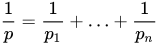
In terms of Schatten norms, for satisfying we have for the same constant that
If, moreover, (and consequently ), and , then
for a constant only dependent on . The latter is a quite nontrivial but useful result,[3] which in the double operator integral case implies that every Lipschitz function is actually operator-Lipschitz on , .[4]
Taylor expansion and quantum theory
The terms in the Taylor expansion of are multiple operator integrals. The Taylor expansion for coincides with the Dyson series.
References
^V. V. Peller, "Multiple operator integrals and higher operator derivatives", Journal of Functional Analysis, vol. 233, issue 2 (2006).doi:10.1016/j.jfa.2005.09.003
^N. A. Azamov, A. L. Carey, P. G. Dodds and F. A. Sukochev, "Operator Integrals, Spectral Shift, and Spectral Flow", Canadian Journal of Mathematics, vol. 61, no. 2 (2009), pp. 241--263. doi:10.4153/CJM-2009-012-0
^D. Potapov, A. Skripka, F. Sukochev, "Spectral shift function of higher order", Inventiones Mathematicae, vol. 193, no. 3 (2013), pp. 501--538.
^D. Potapov, F. Sukochev. "Operator-Lipschitz functions in Schatten--von Neumann classes.", Acta Mathematica, vol. 207, no. 2 (2011), pp 375--389. doi:10.1007/s11511-012-0072-8
Content Disclaimer
Informasi ini disarikan dari Wikipedia dan disajikan kembali untuk tujuan edukasi. Konten tersedia di bawah lisensi CC BY-SA 3.0. Kami tidak bertanggung jawab atas ketidakakuratan data yang bersumber dari kontribusi publik tersebut.
The information displayed on this website is sourced in part or in whole from Wikipedia and has been adapted for the purpose of restating it. We strive to provide accurate and relevant information, however:
There is no guarantee of absolute accuracy. Wikipedia is an open, collaborative project that can be edited by anyone, so information is subject to change.
It is not intended to constitute professional advice. The content displayed is for informational and educational purposes only. For important decisions (e.g., medical, legal, or financial), please consult a professional.
Content copyright. Wikipedia is licensed under the Creative Commons Attribution-ShareAlike License (CC BY-SA). This means that content may be reused with appropriate attribution and shared under a similar license.
Responsible use. Any risk arising from the use of information from this website is entirely the responsibility of the user.


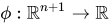















![{\displaystyle \phi =f^{[n]}}](https://wikimedia.org/api/rest_v1/media/math/render/svg/a3ec3183eace996d6254ca736c78bb4b3223a554)

![{\displaystyle f^{[0]}(\lambda _{0}):=f(\lambda _{0})}](https://wikimedia.org/api/rest_v1/media/math/render/svg/1352d9cf3f6005acd4185ad3d53197efc212e98e)
![{\displaystyle f^{[n]}(\lambda _{0},\ldots ,\lambda _{n}):=\lim _{x\in \mathbb {R} \setminus \{\lambda _{0}\},x\to \lambda _{n}}{\frac {f^{[n-1]}(\lambda _{0},\ldots ,\lambda _{n-1})-f^{[n-1]}(\lambda _{1},\ldots ,\lambda _{n-1},x)}{\lambda _{0}-x}}.}](https://wikimedia.org/api/rest_v1/media/math/render/svg/29942eb5898a0d8a087575eff8378095699aea9b)
![{\displaystyle f^{[n]}(\lambda _{1},\ldots ,\lambda _{n})=f^{[n]}(\lambda _{\sigma (1)},\ldots ,\lambda _{\sigma (n)})}](https://wikimedia.org/api/rest_v1/media/math/render/svg/638a64a174b62716d0fd100451aa9b8e9cff82ae)

![{\displaystyle f^{[n]}(\lambda ,\ldots ,\lambda )={\frac {1}{n!}}f^{(n)}(\lambda )}](https://wikimedia.org/api/rest_v1/media/math/render/svg/defb078ec5b212e430cc5b08d864b7b096e44f58)

![{\displaystyle f^{[1]}(\lambda ,\mu )={\frac {f(\lambda )-f(\mu )}{\lambda -\mu }}.}](https://wikimedia.org/api/rest_v1/media/math/render/svg/48f2c94ca390eee4161ffa48d3da24def7d665b8)
![{\displaystyle T_{f^{[n]}}:{\mathcal {B}}({\mathcal {H}})^{\times n}\to {\mathcal {B}}({\mathcal {H}})}](https://wikimedia.org/api/rest_v1/media/math/render/svg/0d1ec0cb48482a287d816b47985f494b0a798fa2)





![{\displaystyle f(A)-f(B)=T_{f^{[1]}}^{A,B}(A-B)}](https://wikimedia.org/api/rest_v1/media/math/render/svg/e9b199ba886d545081e1093706998e387fa1465e)
![{\displaystyle [f(A),B]=T_{f^{[1]}}^{A,A}([A,B])}](https://wikimedia.org/api/rest_v1/media/math/render/svg/55fe1b14737cfc7466869eeb5b7c3eae71079329)
![{\displaystyle f(A)=T_{f^{[0]}}^{A}(),}](https://wikimedia.org/api/rest_v1/media/math/render/svg/be687479a6bea320669ff6b6585218be3fab9be9)
![{\displaystyle T_{f^{[n]}}^{H_{0},\ldots ,H_{j-1},A,H_{j+1},\ldots ,H_{n}}(V_{1},\ldots ,V_{n})-T_{f^{[n]}}^{H_{0},\ldots ,H_{j-1},B,H_{j+1},\ldots ,H_{n}}(V_{1},\ldots ,V_{n})=T_{f^{[n+1]}}^{H_{0},\ldots ,H_{j-1},A,B,H_{j+1},\ldots ,H_{n}}(V_{1},\ldots ,V_{j},A-B,V_{j+1},\ldots ,V_{n})}](https://wikimedia.org/api/rest_v1/media/math/render/svg/973593603ab0dda3e8c2ad72e59499cdd52d1709)
![{\displaystyle T_{f^{[n]}}^{H_{0},\ldots ,H_{n}}(V_{1},\ldots ,V_{j},aV_{j+1},\ldots ,V_{n})-T_{f^{[n]}}^{H_{0},\ldots ,H_{n}}(V_{1},\ldots ,V_{j}a,V_{j+1},\ldots ,V_{n})=T_{f^{[n+1]}}^{H_{0},\ldots ,H_{n}}(V_{1},\ldots ,V_{j},[H_{j},a],V_{j+1},\ldots ,V_{n})}](https://wikimedia.org/api/rest_v1/media/math/render/svg/8708ae0016f5c05c5d80b10e91a2b9ebeb4c8b08)

![{\displaystyle {\rm {Tr}}(V_{0}T_{f^{[n]}}^{H_{0},\ldots ,H_{n}}(V_{1},\ldots ,V_{n}))={\rm {Tr}}(V_{1}T_{f^{[n]}}^{H_{1},\ldots ,H_{n},H_{0}}(V_{2},\ldots ,V_{n},V_{0}))}](https://wikimedia.org/api/rest_v1/media/math/render/svg/337143e35243696f254dec36d315ed81c7687fa4)


![{\displaystyle p,p_{1},\ldots ,p_{n}\in [1,\infty ]}](https://wikimedia.org/api/rest_v1/media/math/render/svg/590eed17ed5afde2371b2ce596882e30520fe67d)


![{\displaystyle \|T_{f^{[n]}}^{H_{0},\ldots ,H_{n}}(V_{1},\ldots ,V_{n})\|_{p}\leq c_{n}\|f^{(n)}\|_{\infty }\|V_{1}\|_{p_{1}}\cdots \|V_{n}\|_{p_{n}},}](https://wikimedia.org/api/rest_v1/media/math/render/svg/f98cdf94c1379491147b472da9c548e87ce5d2ea)


