Draft:Measure of location
   | This article is currently a work-in-progress, resulting from discussion at Talk:Average#Merge proposal, and was last edited 6 days ago, at 13:48, 30 May 2026 (UTC) (). To help avoid edit conflicts, please do not edit this article while this notice is displayed. You may remove this template if there have been no edits for at least 24 hours. |
In mathematics, particularly statistics, a measure of location is an operation that, given a collection or a probability distribution, produces an actual or hypothetical member of it that summarizes it by representing its overall position.
A central value, a mean,[1][2] or an average is a measure of location whose value is generally in the middle of the data, rather than at or towards one end. (The word "average" is also used outside of mathematics to mean common, typical, or normal.)
A "(measure of) central tendency" may refer either to a central value, or, more rarely, to how close the data is to that central value (i.e. the opposite of statistical dispersion or variability). Occasionally authors use central tendency to denote "the tendency of quantitative data to cluster around some central value."[3][4][5]
The phrases "the average" and "the mean" almost always refer specifically to the arithmetic mean, though other meanings are occasionally used depending on the context. For example, in education, "average" sometimes refers to "the three Ms" of (arithmetic) mean, median, and mode; additionally, the harmonic mean is implied in many situations involving rates or ratios.
The arithmetic mean or arithmetic average is the sum of the values divided by the number of values, i.e. . In statistics, this sample mean is denoted using an overline (e.g. , pronounced "x bar"), and this population mean (the expected value) is denoted with the Greek letter mu (, pronounced /'mjuː/).[6]


Properties
Any measure of location, given a collection within its domain, produces a value somewhere on or within the collection's bounding box (and so for real numbers, between its maximum and minimum). Therefore, if a collection consists entirely of the same value, any measure of location of it is that value.[7]
Most measures of location[a] are monotonic, i.e. moving a member of the input in one direction causes the measure to move in the same direction, or equivalently, if two collections of numbers A and B have the same number of elements, and they can be arranged such that each entry in A ≥ the corresponding entry in B, then the measure of A ≥ the measure of B.
All commonly-used measures of location are linearly homogeneous, i.e. multiplying every value by the same scale factor multiplies the measure of location by that same scale factor.
Most measures of location[b] remain identical when the list of items is permuted, i.e. the ordering does not matter.
Uniqueness
The arithmetic mean (L2 center) and mid-range (L∞ center) are unique (when they exist), while the median (L1 center) and mode (L0 center) are not in general unique. This can be understood in terms of convexity of the associated functions (coercive functions).
The 2-norm and ∞-norm are strictly convex, and thus (by convex optimization) the minimizer is unique (if it exists), and exists for bounded distributions. Thus standard deviation about the arithmetic mean is lower than standard deviation about any other point, and the maximum deviation about the midrange is lower than the maximum deviation about any other point.
The 1-norm is not strictly convex, whereas strict convexity is needed to ensure uniqueness of the minimizer. Correspondingly, the median (in this sense of minimizing) is not in general unique, and in fact any point between the two central points of a discrete distribution with an even number of points minimizes average absolute deviation.
The 0-"norm" is not convex (hence not a norm). Correspondingly, the mode is not unique – for example, in a uniform distribution (whether discrete or continuous) any point is the mode.
Types
There are many kinds of measures of location, most of which are considered averages or means, since they are in the center of the data in some sense. Most averages can be seen as minimizing their variation (statistical dispersion) from the data points by some measure, i.e. solving some optimization problem.
Some of the measures of variation are p-norms (though the function corresponding to the L0 space is not a norm, and is thus often referred to in quotes, as the 0-"norm"). For a given (finite) data set X, thought of as a vector x = (x1,…,xn), the dispersion about a point c is the "distance" from x to the constant vector c = (c,…,c) in the p-norm (normalized by the number of points n):

For p = 0 and p = ∞ these functions are defined by taking limits, respectively as p → 0 and p → ∞. For p = 0 the limiting values are 00 = 0 and a0 = 1 for a ≠ 0, so the difference becomes simply equality, so the 0-norm counts the number of unequal points, which is minimized by the mode. For p = ∞ the largest number dominates, and thus the ∞-norm is the maximum difference, which is minimized by the mid-range. Using p = 1 results in the median, and p = 2 the arithmetic mean.
Some of these measures are robust against outliers, such as the median and the trimean.
The table of mathematical symbols explains the symbols used below. Herein, "amn" means argmin and "mx" means maximum.
| Name | Equation or description | As solution to optimization problem | Minimum level of measurement as a scale in Stevens's typology | Result for [1,2,2,3,4,7,9] | Notes | ||||
|---|---|---|---|---|---|---|---|---|---|
| Medoid | A representative object of a set of objects with minimal sum of dissimilarities to all the objects in the set, according to some dissimilarity function | d(y, x) | (depends on d) | (depends on d) | |||||
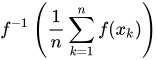
| Quasi-arithmetic mean, generalized f-mean, or Kolmogorov-Nagumo-de Finetti mean | Applies a function before computing the arithmetic mean, and then applies the inverse function to that mean: | f(x) | f⁻¹(y) | (depends on f) | (depends on f) | The optimization problem is valid if f is monotonic. | |||
| Generalized mean, power mean, or Hölder mean | The p-th root of, the sum of p-th powers divided by the count: | xᵖ | p | (depends on p) | (depends on p) | May have problems with negative values. | |||
| Arithmetic mean or centroid | The sum of the values divided by their count: | Minimizing the standard deviation, or: | (y - x)² | x | y | 1 | Interval | (1+...+9)/7 = 28/7 = 4 | |
| Quadratic mean or root mean square (RMS) | The square root of, the sum of squares divided by the count: | (y² - x²)² | x² | √y | 2 | Ratio | √((1²+...+9²)/7) ≈ √23.43 ≈ 4.84 | Has problems with negative values. | |
| Cubic mean | The cube root of, the sum of cubes divided by the count: | (y³ - x³)² | x³ | ∛y | 3 | Ratio | ∛((1³+...+9³)/7) ≈ ∛168.57 ≈ 5.524 | The optimization problem is valid for non-negative numbers (≥0). | |
| Harmonic mean | The count divided by the sum of reciprocals: | (1/y - 1/x)² | 1/x | 1/y | -1 | Ratio | 7/(⅟₁+...+⅟₉) ≈ 7/2.837 ≈ 2.467 | The values should all have the same sign. | |
| Geometric mean | The nth root of the product, where n is the count: | (log(y) - log(x))² | ln(x) | exp(y) | lim →0 | Ratio | The mean is well-defined for all non-negative numbers, but the logarithm is not defined at zero. | ||
| th quantile | 𝜏 is a number between 0 and 1, proportional to the 0-indexing position in the sorted list of values. | Minimizing the total tilted absolute value loss (AKA quantile loss or pinball loss): = | mx{(1-𝜏)(y-x),𝜏(x-y)} = |y-x| + (1-2𝜏)y | 𝜏 | Ordinal | (depends on τ) | Generally not considered an average. The optimization problem is only unique for 0<𝜏<1. | ||
| Minimum | The smallest value in the data set | 0 | Ordinal | 1 | Not an average. | ||||
| Maximum | The largest value in the data set | 1 | Ordinal | 9 | Not an average. | ||||
| Midrange | The midpoint (arithmetic mean) of the maximum and minimum: | Minimizing the maximum deviation: | Ordinal | (1+9)/2 = 5 | |||||
| Lower quartile (Q1) | The value such that one-quarter of the data is less than (or equal to?) it, and three-quarters is greater than (or equal to?) it | = | mx((¾(y-x), ¼(x-y)) = |y-x| + ½y | 1/4 | Ordinal | 2 | Not really an average. | ||
| Upper quartile (Q3) | The value such that three-quarters of the data is less than (or equal to?) it, and one-quarter is greater than (or equal to?) it | = | mx(¼(y-x), ¾(x-y)) = |y-x| - ½y | 3/4 | Ordinal | 7 | Not really an average. | ||
| Midhinge | The arithmetic mean of the lower and upper quartiles: | Ordinal | (2+7) / 2 = 9 / 2 = 4.5 | ||||||
| Median (Q2) | In between the greater half and the lesser half of the data set; not unique if the data set contains an even number of points and the two in the middle are not equal | Minimizing the average absolute deviation, or: | |y - x| | 1/2 | Ordinal | 3 | |||
| Trimean | The sum of the two quartiles and twice the median, divided by four; or equivalently, the arithmetic mean of the midhinge and the median: | Ordinal | |||||||
| Geometric median, spatial median, Euclidean minisum point, Torricelli point, or 1-median | A rotation-invariant generalization of the median for points in . This is the same as the median when applied to one-dimensional data, but it is not the same as taking the median of each dimension independently. It is not invariant to different rescaling of the different dimensions. | Minimizing the sum of the L₂ norms (Euclidean distances): | ⟨3⟩ | ||||||
| Tukey median | Another rotation-invariant generalization of the median for points in ; a point with the property that every halfspace containing it also contains many sample points | Maximizing the Tukey depth: | ⟨3⟩ (with u⃗ = ⟨u⟩ for any non-zero real number u) | ||||||
| Mode | The most frequent value in the data set | Minimizing the variation ratio, or: | Nominal | 2 | |||||
| Lehmer mean | The sum of pth powers divided by the sum of (p-1)th powers: | p | (depends on p) | (depends on p) | |||||
| Contraharmonic mean | The sum of squares divided by the sum: | x (y-x)² | 2 | Ratio | (1²+...+9²)/(1+...+9) = 164/28 ≈ 5.857 | ||||
| Arithmetic mean | see above | (y-x)² | 1 | Interval | (1+...+9)/(1+...+1) = 28/7 = 4 | ||||
| Harmonic mean | see above | (y-x)² / x | 0 | Ratio | (1+...+1)/(⅟₁+...+⅟₉) ≈ 7/2.837 ≈ 2.467 |




![{\displaystyle {\sqrt[{p}]{{\frac {1}{n}}\cdot \sum _{i=1}^{n}x_{i}^{p}}}}](https://wikimedia.org/api/rest_v1/media/math/render/svg/b914d893b094e9e15a5681ef60069e9e5fac54ab)


![{\displaystyle {\sqrt[{3}]{{\frac {1}{n}}\sum _{i=1}^{n}x_{i}^{3}}}=}](https://wikimedia.org/api/rest_v1/media/math/render/svg/a551b80abca137c08ada03c3300a1ed9f99199a6)
![{\displaystyle {\sqrt[{3}]{{\frac {1}{n}}\left(x_{1}^{3}+\cdots +x_{n}^{3}\right)}}}](https://wikimedia.org/api/rest_v1/media/math/render/svg/ff16a67af77a08fea7cd7899dc3d1c248b4cb94b)


![{\displaystyle {\sqrt[{n}]{\prod _{i=1}^{n}x_{i}}}=}](https://wikimedia.org/api/rest_v1/media/math/render/svg/eac0cd3444df51aec28b3018606862f54f0b578c)
![{\displaystyle {\sqrt[{n}]{x_{1}\times \dotsb \times x_{n}}}}](https://wikimedia.org/api/rest_v1/media/math/render/svg/ba65fbbb8018160fc57127fb7a797b64970deb74)

![{\displaystyle {\sqrt[{7}]{1{\times }\cdots {\times }9}}\approx }](https://wikimedia.org/api/rest_v1/media/math/render/svg/8b40b2f62d8af0a148b5c10d634eff494e6a02c9)
![{\displaystyle {\sqrt[{7}]{3024}}\approx 3.1421}](https://wikimedia.org/api/rest_v1/media/math/render/svg/c6993b56e7aafa22bd52e2d63f49d1c62c316f5d)


Other means
- Arithmetic-geometric mean
- Arithmetic-harmonic mean
- Cesàro mean
- Chisini mean
- Elementary symmetric mean
- Geometric-harmonic mean
- Grand mean
- Heinz mean
- Heronian mean
- Identric mean
- Logarithmic mean
- Moving average
- Neuman–Sándor mean
- Rényi's entropy (a generalized f-mean)
- Spherical mean
- Stolarsky mean
- Weighted geometric mean
- Weighted harmonic mean
Arithmetic mean
The mean of a probability distribution is the long-run arithmetic average value of a random variable having that distribution. If the random variable is denoted by , then the mean is also known as the expected value of (denoted ). For a discrete probability distribution, the mean is given by , where the sum is taken over all possible values of the random variable and is the probability mass function. For a continuous distribution, the mean is , where is the probability density function.[8] In all cases, including those in which the distribution is neither discrete nor continuous, the mean is the Lebesgue integral of the random variable with respect to its probability measure. The mean need not exist or be finite; for some probability distributions the mean is infinite (+∞ or −∞), while for others the mean is undefined.


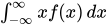

In some circumstances, mathematicians may calculate a mean of an infinite (or even an uncountable) set of values. This can happen when calculating the mean value of a function . Intuitively, a mean of a function can be thought of as calculating the area under a section of a curve, and then dividing by the length of that section. This can be done crudely by counting squares on graph paper, or more precisely by integration. The integration formula is written as:


In this case, care must be taken to make sure that the integral converges. But the mean may be finite even if the function itself tends to infinity at some points.
Quasi-arithmetic means
[table with columns "Name", "", "", "Formula", "Optimization problem"]}}


The arithmetic mean, the geometric mean, and the harmonic mean are known collectively as the Pythagorean means.[9]
In mathematics, the three classical Pythagorean means are the arithmetic mean (AM), the geometric mean (GM), and the harmonic mean (HM). These means were studied with proportions by Pythagoreans and later generations of Greek mathematicians[10] because of their importance in geometry and music.
Arithmetic mean (AM)
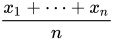
The arithmetic mean (or simply mean or average) of a list of numbers, is the sum of all of the numbers divided by their count. Similarly, the mean of a sample , usually denoted by , is the sum of the sampled values divided by the number of items in the sample.


For example, the arithmetic mean of five values: 4, 36, 45, 50, 75 is:

Geometric mean (GM)
The geometric mean is an average that is useful for sets of positive numbers, that are interpreted according to their product (as is the case with rates of growth) and not their sum (as is the case with the arithmetic mean):[1]

For example, the geometric mean of five values: 4, 36, 45, 50, 75 is:
![{\displaystyle (4\times 36\times 45\times 50\times 75)^{\frac {1}{5}}={\sqrt[{5}]{24\;300\;000}}=30.}](https://wikimedia.org/api/rest_v1/media/math/render/svg/3b516046ef2a7b8b23301b7ab228cec73f38e062)
Harmonic mean (HM)
The harmonic mean is an average which is useful for sets of numbers which are defined in relation to some unit, as in the case of speed (i.e., distance per unit of time):
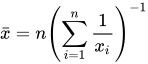
For example, the harmonic mean of the five values: 4, 36, 45, 50, 75 is

If we have five pumps that can empty a tank of a certain size in respectively 4, 36, 45, 50, and 75 minutes, then the harmonic mean of tells us that these five different pumps working together will pump at the same rate as five pumps that can each empty the tank in minutes.

Power mean
The generalized mean, also known as the power mean or Hölder mean, abstracts several other means. It is defined for positive numbers by[1]


This, as a function of , is well defined on , but can be extended continuously to .[11] By choosing different values for , other well known means are retrieved.



| Name | Exponent | Value |
|---|---|---|
| Minimum | ||
| Harmonic mean | ||
| Geometric mean | ||
| Arithmetic mean | ||
| Root mean square | ||
| Cubic mean | ||
| Maximum |




![{\displaystyle {\sqrt[{n}]{x_{1}\dots x_{n}}}}](https://wikimedia.org/api/rest_v1/media/math/render/svg/1af36d22e6641f7ad5ac4cb1973aed19f22c360f)



![{\displaystyle {\sqrt[{3}]{\frac {x_{1}^{3}+\dots +x_{n}^{3}}{n}}}}](https://wikimedia.org/api/rest_v1/media/math/render/svg/e82e4236bdf98c1e7d86ce7b481d2c49d34a4676)


Quasi-arithmetic mean
A similar approach to the power mean is the -mean, also known as the quasi-arithmetic mean. For an injective function on an interval and real numbers we define their -mean as




By choosing different functions , other well known means are retrieved.
| Mean | Function[note 1] | |
|---|---|---|
| Arithmetic mean | ||
| Geometric mean | [note 2] | |
| Harmonic mean | ||
| Power mean | [note 3] |


![{\displaystyle ]0,+\infty [}](https://wikimedia.org/api/rest_v1/media/math/render/svg/e91ea5ab8b69e30f90c2bdf5db4b620815bde815)


Other central values
[table with columns "Name", "Formula or description", "Optimization problem"]}}
Clustering
Instead of a single central point, one can ask for multiple points such that the variation from these points is minimized. This leads to cluster analysis, where each point in the data set is clustered with the nearest "center". Most commonly, using the 2-norm generalizes the mean to k-means clustering, while using the 1-norm generalizes the (geometric) median to k-medians clustering. Using the 0-norm simply generalizes the mode (most common value) to using the k most common values as centers.
Unlike the single-center statistics, this multi-center clustering cannot in general be computed in a closed-form expression, and instead must be computed or approximated by an iterative method; one general approach is expectation–maximization algorithms.
Information geometry
The notion of a "center" as minimizing variation can be generalized in information geometry as a distribution that minimizes divergence (a generalized distance) from a data set. The most common case is maximum likelihood estimation, where the maximum likelihood estimate (MLE) maximizes likelihood (minimizes expected surprisal), which can be interpreted geometrically by using entropy to measure variation: the MLE minimizes cross-entropy (equivalently, relative entropy, Kullback–Leibler divergence).
A simple example of this is for the center of nominal data: instead of using the mode (the only single-valued "center"), one often uses the empirical measure (the frequency distribution divided by the sample size) as a "center". For example, given binary data, say heads or tails, if a data set consists of 2 heads and 1 tails, then the mode is "heads", but the empirical measure is 2/3 heads, 1/3 tails, which minimizes the cross-entropy (total surprisal) from the data set. This perspective is also used in regression analysis, where least squares finds the solution that minimizes the distances from it, and analogously in logistic regression, a maximum likelihood estimate minimizes the surprisal (information distance).
Variants
(these are listed separately because they can be applied to any kind of mean)
Weighted mean
The weighted arithmetic mean (or weighted average) is used if one wants to combine average values from different sized samples of the same population, and is define by[1]

where and are the mean and size of sample respectively. In other applications, they represent a measure for the reliability of the influence upon the mean by the respective values.




Weighted arithmetic mean: an arithmetic mean that incorporates weighting to certain data elements.
The weights may be assigned based on the original arrangement of the data points, the ranking of the values, or some combination.[12]
Winsorized mean
Winsorized mean: Similar to the truncated mean, but, rather than deleting the extreme values, they are set equal to the largest and smallest values that remain
Winsorized mean: an arithmetic mean in which extreme values are replaced by values closer to the median.
Truncated mean
Truncated mean: The arithmetic mean of data values after a certain number or proportion of the highest and lowest data values have been discarded
Sometimes, a set of numbers might contain outliers. Often, outliers are erroneous data caused by artifacts. In this case, one can use a truncated mean. It involves discarding given parts of the data at the top or the bottom end, typically an equal amount at each end and then taking the arithmetic mean of the remaining data. A specific example of a truncated mean is the interquartile mean.
Interquartile mean: A special case of the truncated mean, using the interquartile range. A special case of the inter-quantile truncated mean, which operates on quantiles (often deciles or percentiles) that are equidistant but on opposite sides of the median.
Truncated mean or trimmed mean: the arithmetic mean of data values after a certain number or proportion of the highest and lowest data values have been discarded.
Interquartile mean: a truncated mean based on data within the interquartile range.
Moving average
Given a time series, such as daily stock market prices or yearly temperatures, people often want to create a smoother series.[13] This helps to show underlying trends or perhaps periodic behavior. An easy way to do this is the moving average: one chooses a number n and creates a new series by taking the arithmetic mean of the first n values, then moving forward one place by dropping the oldest value and introducing a new value at the other end of the list, and so on. This is the simplest form of moving average. More complicated forms involve using a weighted average. The weighting can be used to enhance or suppress various periodic behaviors and there is extensive analysis of what weightings to use in the literature on filtering. In digital signal processing the term "moving average" is used even when the sum of the weights is not 1.0 (so the output series is a scaled version of the averages).[14] The reason for this is that the analyst is usually interested only in the trend or the periodic behavior.
Relationships
For unimodal distributions the following bounds are known and are sharp:[15]
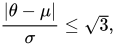
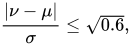
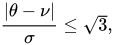
where μ is the mean, ν is the median, θ is the mode, and σ is the standard deviation.
For every distribution,[16][17]
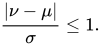

PR is the diameter of a circle centered on O; its radius AO is the arithmetic mean of a and b. Triangle PGR is a right triangle from Thales's theorem, enabling use of the geometric mean theorem to show that its altitude GQ is the geometric mean. For any ratio a:b, AO ≥ GQ.
AM, GM, and HM of nonnegative real numbers satisfy these inequalities:[18]

Equality holds if all the elements of the given sample are equal.
Applications


The most commonly used definition of the average is the arithmetic mean,[20] i.e. the sum divided by the count, so the "average" of the list of numbers [2, 3, 4, 7, 9] is generally considered to be (2+3+4+7+9)/5 = 25/5 = 5.
However, other meanings are sometimes used depending on the context, which can lead to confusion; for instance, in teaching, "average" sometimes refers to "the three Ms": mean, median, and mode.[21][22][23][24][25][26][27]
The median, defined as the value in the center after sorting the group, is usually used as the average in situations where the data is skewed or has outliers, in order to focus on the main part of the group rather than the long tail. For example, the average personal income is usually given as the median income, so that it represents the majority of the population rather than being overly influenced by the much higher incomes of the few rich people.[28]
The harmonic mean, defined as the reciprocal of the mean of the reciprocals, is used in a variety of situations involving rates or ratios, such as computing the average speed from multiple measurements taken over the same distance[29]. Indeed, unlike an arithmetic mean or median of speeds, a harmonic mean of speeds will give the value of the constant speed that would cause one to travel the same distance in the same amount of time.
The mode represents the most common value found in the group. It can be used when the data is categorical rather than numeric,[30] when the frequency of each value is relevant (such as where a histogram, bar chart, or probability density function is being referenced),[31] or to find a value that represents the majority of the group.[32]
Other statistics that can be used as an average include the mid-range, the quadratic mean or the geometric mean, but they are rarely referred to as "the average".
These different quantities all estimate the central tendency of a group, with each having their advantages and issues. Mathematically, they can be thought as solving different variational problems.
A type of average used in finance is the average percentage return, which is an example of a geometric mean. When the returns are annual, it is called the Compound Annual Growth Rate (CAGR). For example, if we are considering a period of two years, and the investment return in the first year is −10% and the return in the second year is +60%, then the average percentage return or CAGR, R, can be obtained by solving the equation: (1 − 10%) × (1 + 60%) = (1 − 0.1) × (1 + 0.6) = (1 + R) × (1 + R). The value of R that makes this equation true is 0.2, or 20%. This means that the total return over the 2-year period is the same as if there had been 20% growth each year. The order of the years makes no difference – the average percentage returns of +60% and −10% is the same result as that for −10% and +60%.
This method can be generalized to examples in which the periods are not equal. For example, consider a period of a half of a year for which the return is −23% and a period of two and a half years for which the return is +13%. The average percentage return for the combined period is the single year return, R, that is the solution of the following equation: (1 − 0.23)0.5 × (1 + 0.13)2.5 = (1 + R)0.5+2.5, giving an average return R of 0.0600 or 6.00%.


In descriptive statistics, the mean may be confused with the median, mode or mid-range, as any of these may colloquially be called an "average" (more formally, a measure of central tendency). The mean of a set of observations is the arithmetic average of the values; however, for skewed distributions, the mean is not necessarily the same as the middle value (median), or the most likely value (mode). For example, mean income is typically skewed upwards by a small number of people with very large incomes, so that the majority have an income lower than the mean. By contrast, the median income is the level at which half the population is below and half is above. The mode income is the most likely income and favors the larger number of people with lower incomes. While the median and mode are often more intuitive measures for such skewed data, many skewed distributions are in fact best described by their mean, including the exponential and Poisson distributions.
Angles, times of day, and other cyclical quantities require modular arithmetic to add and otherwise combine numbers. These quantities can be averaged using the circular mean. In all these situations, it is possible that no mean exists, for example if all points being averaged are equidistant. Consider a color wheel—there is no mean to the set of all colors. Additionally, there may not be a unique mean for a set of values: for example, when averaging points on a clock, the mean of the locations of 11:00 and 13:00 is 12:00, but this location is equivalent to that of 00:00.
The Fréchet mean gives a manner for determining the "center" of a mass distribution on a surface or, more generally, Riemannian manifold. Unlike many other means, the Fréchet mean is defined on a space whose elements cannot necessarily be added together or multiplied by scalars.
In geometry, there are thousands of different definitions for the center of a triangle that can all be interpreted as the mean of a triangular set of points in the plane.[34]
Swanson's rule
This is an approximation to the mean for a moderately skewed distribution.[35] It is used in hydrocarbon exploration and is defined as:

where , and are the 10th, 50th and 90th percentiles of the distribution, respectively.


History
The term central tendency dates from the late 1920s.[4]
Origin
The first recorded time that the arithmetic mean was extended from 2 to n cases for the use of estimation was in the sixteenth century. From the late sixteenth century onwards, it gradually became a common method to use for reducing errors of measurement in various areas.[36][37] At the time, astronomers wanted to know a real value from noisy measurement, such as the position of a planet or the diameter of the moon. Using the mean of several measured values, scientists assumed that the errors add up to a relatively small number when compared to the total of all measured values. The method of taking the mean for reducing observation errors was mainly developed in astronomy.[36][38] A possible precursor to the arithmetic mean is the mid-range (the mean of the two extreme values), used for example in Arabian astronomy of the ninth to eleventh centuries, but also in metallurgy and navigation.[37]
However, there are various older vague references to the use of the arithmetic mean (which are not as clear, but might reasonably have to do with our modern definition of the mean). In a text from the 4th century, it was written that (text in square brackets is a possible missing text that might clarify the meaning):[39]
- In the first place, we must set out in a row the sequence of numbers from the monad up to nine: 1, 2, 3, 4, 5, 6, 7, 8, 9. Then we must add up the amount of all of them together, and since the row contains nine terms, we must look for the ninth part of the total to see if it is already naturally present among the numbers in the row; and we will find that the property of being [one] ninth [of the sum] only belongs to the [arithmetic] mean itself...
Even older potential references exist. There are records that from about 700 BC, merchants and shippers agreed that damage to the cargo and ship (their "contribution" in case of damage by the sea) should be shared equally among themselves.[38] This might have been calculated using the average, although there seem to be no direct record of the calculation.
Etymology
The root is found in Arabic as عوار ʿawār, a defect, or anything defective or damaged, including partially spoiled merchandise; and عواري ʿawārī (also عوارة ʿawāra) = "of or relating to ʿawār, a state of partial damage".[c] Within the Western languages the word's history begins in medieval sea-commerce on the Mediterranean. 12th and 13th century Genoa Latin avaria meant "damage, loss and non-normal expenses arising in connection with a merchant sea voyage"; and the same meaning for avaria is in Marseille in 1210, Barcelona in 1258 and Florence in the late 13th.[d] 15th-century French avarie had the same meaning, and it begot English "averay" (1491) and English "average" (1502) with the same meaning. Today, Italian avaria, Catalan avaria and French avarie still have the primary meaning of "damage". The transformation of the meaning in English began in later medieval and early modern Western merchant-marine law contracts under which if the ship met a bad storm and some of the goods had to be thrown overboard to make the ship lighter and safer, then all merchants whose goods were on the ship were to suffer proportionately (and not whoever's goods were thrown overboard); and more generally there was to be proportionate distribution of any avaria[citation needed]. From there the word was adopted by British insurers, creditors, and merchants for talking about their losses as being spread across their whole portfolio of assets and having a mean proportion.[d][40]
Marine damage is either particular average, which is borne only by the owner of the damaged property, or general average, where the owner can claim a proportional contribution from all the parties to the marine venture. The type of calculations used in adjusting general average gave rise to the use of "average" to mean "arithmetic mean".
A second English usage, documented as early as 1674 and sometimes spelled "averish", is as the residue and second growth of field crops, which were considered suited to consumption by draught animals ("avers").[41]
There is earlier (from at least the 11th century), unrelated use of the word. It appears to be an old legal term for a tenant's day labour obligation to a sheriff, probably anglicised from "avera" found in the English Domesday Book (1085).
The Oxford English Dictionary, however, says that derivations from German hafen haven, and Arabic ʿawâr loss, damage, have been "quite disposed of" and the word has a Romance origin.[42]
Limitations
Due to the aforementioned colloquial nature of the term "average", the term can be used to obfuscate the true meaning of data and suggest varying answers to questions based on the averaging method (most frequently arithmetic mean, median, or mode) used. In his article "Framed for Lying: Statistics as In/Artistic Proof", University of Pittsburgh faculty member Daniel Libertz comments that statistical information is frequently dismissed from rhetorical arguments for this reason.[43] However, due to their persuasive power, averages and other statistical values should not be discarded completely, but instead used and interpreted with caution. Libertz invites us to engage critically not only with statistical information such as averages, but also with the language used to describe the data and its uses, saying: "If statistics rely on interpretation, rhetors should invite their audience to interpret rather than insist on an interpretation."[43] In many cases, data and specific calculations are provided to help facilitate this audience-based interpretation.
See also

- Average absolute deviation
- Central limit theorem
- Expected value
- Law of averages
- Population mean
- Sample mean
- Central moment
- Location parameter
- Statistical dispersion
- Median
- Mode
- Descriptive statistics
- Kurtosis
- Mean value theorem
- Moment (mathematics)
- Summary statistics
- Taylor's law
- Simplicial depth
Notes
- ^ One exception to this is the mode; for example, the mode of [1, 1, 2, 2, 2] is 2, but the mode of [1, 1, 2, 3, 4] is 1. Also, most measures of location are strictly monotone, but some, such as the maximum and minimum, median, truncated mean, and winsorized mean, are only weakly monotone, and may remain the same after some of the values are increased.
- ^ Exceptions to this may include weighted averages (if the weights are assigned by position) and moving averages (if the entire resulting sequence or curve is considered). Moving averages are often done using position-weighted averages.
- ^ Medieval Arabic had عور ʿawr meaning "blind in one eye" and عوار ʿawār meant "any defect, or anything defective or damaged". Some medieval Arabic dictionaries are at Baheth.info Archived 2013-10-29 at the Wayback Machine, and some translation to English of what's in the medieval Arabic dictionaries is in Lane's Arabic-English Lexicon, pages 2193 and 2195. The medieval dictionaries do not list the word-form عوارية ʿawārīa. ʿAwārīa can be naturally formed in Arabic grammar to refer to things that have ʿawār, but in practice in medieval Arabic texts ʿawārīa is a rarity or non-existent, while the forms عواري ʿawārī and عوارة ʿawāra are frequently used when referring to things that have ʿawār or damage – this can be seen in the searchable collection of medieval texts at AlWaraq.net (book links are clickable on righthand side).
- ^ a b The Arabic origin of avaria was first reported by Reinhart Dozy in the 19th century. Dozy's original summary is in his 1869 book Glossaire. Summary information about the word's early records in Italian-Latin, Italian, Catalan, and French is at avarie @ CNRTL.fr Archived 2019-01-06 at the Wayback Machine. The seaport of Genoa is the location of the earliest-known record in European languages, year 1157. A set of medieval Latin records of avaria at Genoa is in the downloadable lexicon Vocabolario Ligure, by Sergio Aprosio, year 2001, avaria in Volume 1 pages 115-116. Many more records in medieval Latin at Genoa are at StoriaPatriaGenova.it, usually in the plurals avariis and avarias. At the port of Marseille in the 1st half of the 13th century notarized commercial contracts have dozens of instances of Latin avariis (ablative plural of avaria), as published in Blancard year 1884. Some information about the English word over the centuries is at NED (year 1888). See also the definition of English "average" in English dictionaries published in the early 18th century, i.e., in the time period just before the big transformation of the meaning: Kersey-Phillips' dictionary (1706), Blount's dictionary (1707 edition), Hatton's dictionary (1712), Bailey's dictionary (1726), Martin's dictionary (1749). Some complexities surrounding the English word's history are discussed in Hensleigh Wedgwood year 1882 page 11 and Walter Skeat year 1888 page 781. Today there is consensus that: (#1) today's English "average" descends from medieval Italian avaria, Catalan avaria, and (#2) among the Latins the word avaria started in the 12th century and it started as a term of Mediterranean sea-commerce, and (#3) there is no root for avaria to be found in Latin, and (#4) a substantial number of Arabic words entered Italian, Catalan and Provençal in the 12th and 13th centuries starting as terms of Mediterranean sea-commerce, and (#5) the Arabic ʿawār | ʿawārī is phonetically a good match for avaria, as conversion of w to v was regular in Latin and Italian, and -ia is a suffix in Italian, and the Western word's earliest records are in Italian-speaking locales (writing in Latin). And most commentators agree that (#6) the Arabic ʿawār | ʿawārī = "damage | relating to damage" is semantically a good match for avaria = "damage or damage expenses". A minority of commentators have been dubious about this on the grounds that the early records of Italian-Latin avaria have, in some cases, a meaning of "an expense" in a more general sense – see TLIO (in Italian). The majority view is that the meaning of "an expense" was an expansion from "damage and damage expense", and the chronological order of the meanings in the records supports this view, and the broad meaning "an expense" was never the most commonly used meaning. On the basis of the above points, the inferential step is made that the Latinate word came or probably came from the Arabic word.


References
- ^ a b c d "Mean | mathematics". Encyclopedia Britannica. Retrieved 2020-08-21.
- ^ Why Few Math Students Actually Understand the Meaning of Means (YouTube video). Math The World. 2024-08-27. Retrieved 2024-09-10.
- ^ Weisberg H.F (1992) Central Tendency and Variability, Sage University Paper Series on Quantitative Applications in the Social Sciences, ISBN 0-8039-4007-6 p.2
- ^ a b Upton, G.; Cook, I. (2008) Oxford Dictionary of Statistics, OUP ISBN 978-0-19-954145-4 (entry for "central tendency")
- ^ Dodge, Y. (2003) The Oxford Dictionary of Statistical Terms, OUP for International Statistical Institute. ISBN 0-19-920613-9 (entry for "central tendency")
- ^ Underhill, L.G.; Bradfield d. (1998) Introstat, Juta and Company Ltd. ISBN 0-7021-3838-X p. 181
- ^ Nagumo, Mitio (1930) [Eingegangen am 1. November, 1929]. "9. Über eine Klasse der Mittelwerte". Japanese Journal of Mathematics. VII: 71–79. HathiTrust record 006954247, items inu.30000091433023, uc1.31822020414991, rul.39030029662022.
- ^ Weisstein, Eric W. "Population Mean". mathworld.wolfram.com. Retrieved 2020-08-21.
- ^ Cantrell, David W. "Pythagorean Means". MathWorld. Retrieved 2025-11-04.
- ^ Heath, Thomas. History of Ancient Greek Mathematics.
- ^ P. S. Bullen: Handbook of Means and Their Inequalities. Dordrecht, Netherlands: Kluwer, 2003, pp. 176.
- ^ Merigo, Jose M.; Cananovas, Montserrat (June 2010). "The Generalized Hybrid Averaging Operator and its Application in Decision Making / La media generalizada híbrida y su aplicación en la toma de decisiones". Revista de Métodos Cuantitativos para la Economía y la Empresa [Journal of Quantitative Methods for Economics and Business Administration]. 9: 69–84. doi:10.46661/revmetodoscuanteconempresa.2149. ISSN 1886-516X.
- ^ Box, George E.P.; Jenkins, Gwilym M. (1976). Time Series Analysis: Forecasting and Control (revised ed.). Holden-Day. ISBN 0816211043.
- ^ Haykin, Simon (1986). Adaptive Filter Theory. Prentice-Hall. ISBN 0130040525.
- ^ Johnson NL, Rogers CA (1951) "The moment problem for unimodal distributions". Annals of Mathematical Statistics, 22 (3) 433–439
- ^ Hotelling H, Solomons LM (1932) The limits of a measure of skewness. Annals Math Stat 3, 141–114
- ^ Garver (1932) Concerning the limits of a mesuare of skewness. Ann Math Stats 3(4) 141–142
- ^ Djukić, Dušan; Janković, Vladimir; Matić, Ivan; Petrović, Nikola (2011-05-05). The IMO Compendium: A Collection of Problems Suggested for The International Mathematical Olympiads: 1959-2009 Second Edition. Springer Science & Business Media. ISBN 978-1-4419-9854-5.
- ^ Cantrell, David W. "Pythagorean Means". MathWorld. Retrieved 2025-11-04.
- ^ Kaplan, Jennifer; Fisher, Dianne G.; Rogness, Neal T. (July 2010). "Lexical Ambiguity in Statistics: How students use and define the words: association, average, confidence, random and spread" [part 2] (PDF). Journal of Statistics Education. 18 (2). doi:10.1080/10691898.2010.11889491. eISSN 1069-1898.
- ^ Stack, Sue; Watson, Jane; Hindley, Sue; Samson, Pauline; Devlin, Robyn (2010). "What's average?". Australian Mathematics Teacher (AMT). 66 (3): 7–15. ISSN 0045-0685. Academia 48155690. EBSCOhost 53382428. Informit 10.3316/informit.354027435519820.
- ^ Quinnell, Lorna (September 2017). "Those muddling M's: Scaffolding understanding of averages in mathematics". The Australian Mathematics Teacher (AMT). 73 (3): 6–12. ISSN 0045-0685. EBSCOhost 125324609. Informit 10.3316/informit.123380293707263, 10.3316/aeipt.218997.
- ^ Watson, Jane M.; Moritz, Jonathan B. (1999). "The Development of Concepts of Average". Focus on Learning Problems in Mathematics. 21 (4): 15–39. ISSN 0272-8893. ERIC EJ612005.
- ^ Watson, Jane M. (May 2007). "The Role of Cognitive Conflict in Developing Students' Understanding of Average". Educational Studies in Mathematics. 65: 21–47. doi:10.1007/s10649-006-9043-3. ISSN 0013-1954.
- ^ Kaplan, Jennifer J.; Fisher, Diane G.; Rogness, Neal T. (2009). "Lexical Ambiguity in Statistics: What do students know about the words association, average, confidence, random and spread?" [part 1]. Journal of Statistics Education. 17 (3). doi:10.1080/10691898.2009.11889535. eISSN 1069-1898.
- ^ Triola, Mario F. (2014). Elementary Statistics (PDF) (12th Pearson New International ed.). Pearson Education Limited. p. 53. ISBN 978-1-292-03941-1.
- ^ Watson, Jane; Chick, Helen (July 2–6, 2012). Average Revisited in Context. 35th Annual Meeting of the Mathematics Education Research Group of Australasia (MERGA), Singapore. Adelaide SA, Australia: Mathematics Education Research Group of Australasia. pp. 753–760. This research was partially funded by ARC Linkage Grant No. LP0669106.
- ^ "Mean or median? 'Average' household income". Statistics for the Terrified. Concept Stew Ltd. 4 April 2005. Archived from the original on 2005-12-05.
- ^ de Mestre, Neville (2019). "discovery: What do you mean by an average?". Australian Mathematics Education Journal (AMEJ). 1 (4): 24–25. ISSN 2652-0176. EBSCOhost 140411813. Informit 10.3316/informit.837688193205822.
- ^ "Teacher Discussion - Meet the Averages" [based on an article in The Mercury, Sunday, 16 August, 1998, p.9]. Numeracy in the News. Archived from the original on 2011-03-01.
- ^ Landtblom, Karin (July 2018). Sorto, M. A.; White, A.; Guyot, L. (eds.). IS DATA A QUANTITATIVE THING? AN ANALYSIS OF THE CONCEPT OF THE MODE IN TEXTBOOKS FOR GRADE 4-6 (PDF). Tenth International Conference on Teaching Statistics (ICOTS10), Kyoto, Japan. Looking back, looking forward. Voorburg, The Netherlands: International Statistical Institute. Archived from the original (PDF) on 2019-12-18.
- ^ Fowler, Elizabeth M. (August 4, 1956). "The Three Averages: A Study of How and Why Statisticians Make Use of Mean, Median and Mode / 3 AVERAGES USED BY STATISTICIANS". New York Times. pp. 19, 25 [but digitally tagged as 28, 34]. ProQuest 113794286.
- ^ "AP Statistics Review - Density Curves and the Normal Distributions". Archived from the original on 2 April 2015. Retrieved 16 March 2015.
- ^ Narboux, Julien; Braun, David (2016). "Towards a certified version of the encyclopedia of triangle centers" (PDF). Mathematics in Computer Science. 10 (1): 57–73. doi:10.1007/s11786-016-0254-4. MR 3483261.
under the guidance of Clark Kimberling, an electronic encyclopedia of triangle centers (ETC) has been developed, it contains more than 7000 centers and many properties of these points
- ^ Hurst A, Brown GC, Swanson RI (2000) Swanson's 30-40-30 Rule. American Association of Petroleum Geologists Bulletin 84(12) 1883-1891
- ^ a b Plackett, R. L. (1958). "Studies in the History of Probability and Statistics: VII. The Principle of the Arithmetic Mean". Biometrika. 45 (1/2): 130–135. doi:10.2307/2333051. JSTOR 2333051.
- ^ a b Eisenhart, Churchill. "The development of the concept of the best mean of a set of measurements from antiquity to the present day." Unpublished presidential address, American Statistical Association, 131st Annual Meeting, Fort Collins, Colorado. 1971.
- ^ a b "Bakker, Arthur. "The early history of average values and implications for education." Journal of Statistics Education 11.1 (2003): 17-26". Archived from the original on 2015-12-04. Retrieved 2015-10-22.
- ^ "Waterfield, Robin. "The theology of arithmetic." On the Mystical, mathematical and Cosmological Symbolism of the First Ten Number (1988). page 70" (PDF). Archived from the original (PDF) on 2016-03-04. Retrieved 2018-11-27.
- ^ "average". Dictionary.com Unabridged (Online). n.d. Retrieved 2023-05-25.
- ^ Ray, John (1674). A Collection of English Words not Generally Used. London: H. Bruges. Retrieved 18 May 2015.
- ^ "average, n.2". Oxford English Dictionary (Online ed.). Oxford University Press. September 2019. Retrieved September 5, 2019. (Subscription or participating institution membership required.)
- ^ a b Libertz, Daniel (2018-12-31). "Framed for Lying: Statistics as In/Artistic Proof". Res Rhetorica. 5 (4). doi:10.29107/rr2018.4.1. ISSN 2392-3113.
Further reading
- Bakker, Arthur (March 2003). "The Early History of Average Values and Implications for Education". Journal of Statistics Education. 11 (1). doi:10.1080/10691898.2003.11910694.
- Edgeworth, F. Y. (1889) [Read May 25, 1885.]. "VII. Observations and Statistics. An Essay on the Theory of Errors of Observation and the First Principles of Statistics". Transactions of the Cambridge Philosophical Society. XIV (II): 138–169. Google Books TdIsAAAAYAAJ. HathiTrust record 000526741, item mdp.39015008919659; record 100324784, item hvd.32044092879402.
- Edgeworth, F. Y. (May 25, 1885). "(4) Observations and statistics : Abstract". Proceedings of the Cambridge Philosophical Society. V (IV): 310–312. Google Books KdIsAAAAYAAJ, zpw1AAAAIAAJ. HathiTrust record 100528415, item hvd.hwhqbe. Internet Archive proceedingscambr05camb, proceedingsofcam5188386camb, proceedingscamb09socigoog.
- "Corrigendum on Mr F. Y. Edgeworth's paper". Proceedings of the Cambridge Philosophical Society. VI (II): 101–102. May 30, 1887. Google Books E501AAAAIAAJ. Internet Archive proceedingscamb12socigoog.
- Kennedy, Christopher; Stanley, Jason (July 2009). "On 'Average'". Mind. 118 (471): 583–646. doi:10.1093/mind/fzp094. eISSN 1460-2113. ISSN 0026-4423.
External links


Category:Arithmetic functions
Category:Means
Category:Summary statistics
Category:Probability theory
Category:Moments (mathematics)
Content Disclaimer
Informasi ini disarikan dari Wikipedia dan disajikan kembali untuk tujuan edukasi. Konten tersedia di bawah lisensi CC BY-SA 3.0. Kami tidak bertanggung jawab atas ketidakakuratan data yang bersumber dari kontribusi publik tersebut.
- The information displayed on this website is sourced in part or in whole from Wikipedia and has been adapted for the purpose of restating it. We strive to provide accurate and relevant information, however:
- There is no guarantee of absolute accuracy. Wikipedia is an open, collaborative project that can be edited by anyone, so information is subject to change.
- It is not intended to constitute professional advice. The content displayed is for informational and educational purposes only. For important decisions (e.g., medical, legal, or financial), please consult a professional.
- Content copyright. Wikipedia is licensed under the Creative Commons Attribution-ShareAlike License (CC BY-SA). This means that content may be reused with appropriate attribution and shared under a similar license.
- Responsible use. Any risk arising from the use of information from this website is entirely the responsibility of the user.