Double complex
In mathematics, specifically Homological algebra, a double complex is a generalization of a chain complex where instead of having a -grading, the objects in the bicomplex have a -grading. The most general definition of a double complex, or a bicomplex, is given with objects in an additive category . A bicomplex[1] is a sequence of objects with two differentials, the horizontal differential


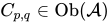

and the vertical differential

which have the compatibility relation

Hence a double complex is a commutative diagram of the form
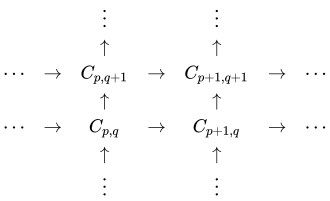
where the rows and columns form chain complexes.
Some authors[2] instead require that the squares anticommute. That is

This eases the definition of Total Complexes. By setting , we can switch between having commutativity and anticommutativity. If the commutative definition is used, this alternating sign will have to show up in the definition of Total Complexes.

Examples
There are many natural examples of bicomplexes that come up in nature. In particular, for a Lie groupoid, there is a bicomplex associated to it[3]pg 7-8 which can be used to construct its de-Rham complex.
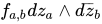
Another common example of bicomplexes are in Hodge theory, where on an almost complex manifold there's a bicomplex of differential forms whose components are linear or anti-linear. For example, if are the complex coordinates of and are the complex conjugate of these coordinates, a -form is of the form


See also
- ^ "Section 12.18 (0FNB): Double complexes and associated total complexes—The Stacks project". stacks.math.columbia.edu. Retrieved 2021-07-08.
- ^ Weibel, Charles A. (1994). An introduction to homological algebra. Cambridge [England]: Cambridge University Press. ISBN 978-1-139-64863-9. OCLC 847527211.
- ^ Block, Jonathan; Daenzer, Calder (2009-01-09). "Mukai duality for gerbes with connection". arXiv:0803.1529 [math.QA].
Additional applications
Content Disclaimer
Informasi ini disarikan dari Wikipedia dan disajikan kembali untuk tujuan edukasi. Konten tersedia di bawah lisensi CC BY-SA 3.0. Kami tidak bertanggung jawab atas ketidakakuratan data yang bersumber dari kontribusi publik tersebut.
- The information displayed on this website is sourced in part or in whole from Wikipedia and has been adapted for the purpose of restating it. We strive to provide accurate and relevant information, however:
- There is no guarantee of absolute accuracy. Wikipedia is an open, collaborative project that can be edited by anyone, so information is subject to change.
- It is not intended to constitute professional advice. The content displayed is for informational and educational purposes only. For important decisions (e.g., medical, legal, or financial), please consult a professional.
- Content copyright. Wikipedia is licensed under the Creative Commons Attribution-ShareAlike License (CC BY-SA). This means that content may be reused with appropriate attribution and shared under a similar license.
- Responsible use. Any risk arising from the use of information from this website is entirely the responsibility of the user.