Distribution function (physics)
 | This article needs additional citations for verification. (January 2026) |
In molecular kinetic theory in physics, a system's distribution function is a function of seven variables, , which gives the number of particles per unit volume in single-particle phase space.[1] It is the number of particles per unit volume having approximately the velocity near the position and time .

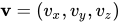


Formula
The usual normalization of the distribution function is where N is the total number of particles and n is the number density of particles – the number of particles per unit volume, or the density divided by the mass of individual particles.

A distribution function may be specialised with respect to a particular set of dimensions. E.g. take the quantum mechanical six-dimensional phase space, and multiply by the total space volume, to give the momentum distribution, i.e. the number of particles in the momentum phase space having approximately the momentum .


Particle distribution functions are often used in plasma physics to describe wave–particle interactions and velocity-space instabilities. Distribution functions are also used in fluid mechanics, statistical mechanics and nuclear physics.
Maxwellian distribution
The basic distribution function uses the Boltzmann constant and temperature with the number density to modify the normal distribution:


![{\displaystyle {\begin{aligned}f&=n\left({\frac {m}{2\pi kT}}\right)^{3/2}\exp \left(-{\frac {mv^{2}}{2kT}}\right)\\[2pt]&=n\left({\frac {m}{2\pi kT}}\right)^{3/2}\exp \left(-{\frac {m(v_{x}^{2}+v_{y}^{2}+v_{z}^{2})}{2kT}}\right).\end{aligned}}}](https://wikimedia.org/api/rest_v1/media/math/render/svg/4b0e44d8ada8a7b24ea3bc7ff9d397eb619a896f)
Related distribution functions may allow bulk fluid flow, in which case the velocity origin is shifted, so that the exponent's numerator is , where is the bulk velocity of the fluid. Distribution functions may also feature non-isotropic temperatures, in which each term in the exponent is divided by a different temperature.


Plasma theories such as magnetohydrodynamics may assume the particles to be in thermodynamic equilibrium. In this case, the distribution function is Maxwellian. This distribution function allows fluid flow and different temperatures in the directions parallel to, and perpendicular to, the local magnetic field. More complex distribution functions may also be used, since plasmas are rarely in thermal equilibrium.
The mathematical analogue of a distribution is a measure; the time evolution of a measure on a phase space is the topic of study in dynamical systems.
References
- ^ Hillery, M.; O'Connell, R.F.; Scully, M.O.; Wigner, E.P. (1984). "Distribution functions in physics: Fundamentals". Physics Reports. 106 (3): 121–167. doi:10.1016/0370-1573(84)90160-1. Retrieved 2025-07-25.
Content Disclaimer
Informasi ini disarikan dari Wikipedia dan disajikan kembali untuk tujuan edukasi. Konten tersedia di bawah lisensi CC BY-SA 3.0. Kami tidak bertanggung jawab atas ketidakakuratan data yang bersumber dari kontribusi publik tersebut.
- The information displayed on this website is sourced in part or in whole from Wikipedia and has been adapted for the purpose of restating it. We strive to provide accurate and relevant information, however:
- There is no guarantee of absolute accuracy. Wikipedia is an open, collaborative project that can be edited by anyone, so information is subject to change.
- It is not intended to constitute professional advice. The content displayed is for informational and educational purposes only. For important decisions (e.g., medical, legal, or financial), please consult a professional.
- Content copyright. Wikipedia is licensed under the Creative Commons Attribution-ShareAlike License (CC BY-SA). This means that content may be reused with appropriate attribution and shared under a similar license.
- Responsible use. Any risk arising from the use of information from this website is entirely the responsibility of the user.