Distributed point function
In cryptography, a distributed point function is a cryptographic primitive that allows two distributed processes to share a piece of information, and compute functions of their shared information, without revealing the information itself to either process. It is a form of secret sharing.[1]
Given any two values and one can define a point function (a variant of the Kronecker delta function) by


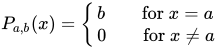
That is, it is zero everywhere except at , where its value is .[1]
A distributed point function consists of a family of functions , parameterized by keys , and a method for deriving two keys and from any two input values and , such that for all ,



where denotes the bitwise exclusive or of the two function values. However, given only one of these two keys, the values of for that key should be indistinguishable from random.[1]


It is known how to construct an efficient distributed point function from another cryptographic primitive, a one-way function.[1]
In the other direction, if a distributed point function is known, then it is possible to perform private information retrieval. As a simplified example of this, it is possible to test whether a key belongs to replicated distributed database without revealing to the database servers (unless they collude with each other) which key was sought. To find the key in the database, create a distributed point function for and send the resulting two keys and to two different servers holding copies of the database. Each copy applies its function or to all the keys in its copy of the database, and returns the exclusive or of the results. The two returned values will differ if belongs to the database, and will be equal otherwise.[1]


References
- ^ a b c d e Gilboa, Niv; Ishai, Yuval (2014), "Distributed point functions and their applications", in Nguyen, Phong Q.; Oswald, Elisabeth (eds.), Advances in Cryptology – EUROCRYPT 2014: 33rd Annual International Conference on the Theory and Applications of Cryptographic Techniques, Copenhagen, Denmark, May 11-15, 2014, Proceedings (PDF), Lecture Notes in Computer Science, vol. 8441, Springer, pp. 640–658, doi:10.1007/978-3-642-55220-5_35, ISBN 978-3-642-55219-9
Content Disclaimer
Informasi ini disarikan dari Wikipedia dan disajikan kembali untuk tujuan edukasi. Konten tersedia di bawah lisensi CC BY-SA 3.0. Kami tidak bertanggung jawab atas ketidakakuratan data yang bersumber dari kontribusi publik tersebut.
- The information displayed on this website is sourced in part or in whole from Wikipedia and has been adapted for the purpose of restating it. We strive to provide accurate and relevant information, however:
- There is no guarantee of absolute accuracy. Wikipedia is an open, collaborative project that can be edited by anyone, so information is subject to change.
- It is not intended to constitute professional advice. The content displayed is for informational and educational purposes only. For important decisions (e.g., medical, legal, or financial), please consult a professional.
- Content copyright. Wikipedia is licensed under the Creative Commons Attribution-ShareAlike License (CC BY-SA). This means that content may be reused with appropriate attribution and shared under a similar license.
- Responsible use. Any risk arising from the use of information from this website is entirely the responsibility of the user.