Disphenocingulum
| Disphenocingulum | |
|---|---|
 | |
| Type | Johnson J89 – J90 – J91 |
| Faces | 20 triangles 4 squares |
| Edges | 38 |
| Vertices | 16 |
| Vertex configuration | 4(32.42) 4(35) 8(34.4) |
| Symmetry group | D2d |
| Properties | convex, elementary |
| Net | |
 | |

In geometry, the disphenocingulum is a Johnson solid with 20 equilateral triangles and 4 squares as its faces.
Properties
The disphenocingulum is named by Johnson (1966). The prefix dispheno- refers to two wedgelike complexes, each formed by two adjacent lunes—a figure of two equilateral triangles at the opposite sides of a square. The suffix -cingulum, literally 'belt', refers to a band of 12 triangles joining the two wedges.[1] The resulting polyhedron has 20 equilateral triangles and 4 squares, making 24 faces.[2]. All of the faces are regular, categorizing the disphenocingulum as a Johnson solid—a convex polyhedron in which all of its faces are regular polygon—enumerated as 90th Johnson solid .[3]. It is an elementary polyhedron, meaning that it cannot be separated by a plane into two small regular-faced polyhedra.[4]

The surface area of a disphenocingulum with edge length can be determined by adding all of its faces, the area of 20 equilateral triangles and 4 squares , and its volume is .[2]


Cartesian coordinates
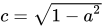
Let be the second smallest positive root of the polynomial and and . Then, the Cartesian coordinates of a disphenocingulum with edge length 2 are given by the union of the orbits of the points under the action of the group generated by reflections about the xz-plane and the yz-plane.[5]




References
- ^ Johnson, N. W. (1966). "Convex polyhedra with regular faces". Canadian Journal of Mathematics. 18: 169–200. doi:10.4153/cjm-1966-021-8. MR 0185507. S2CID 122006114. Zbl 0132.14603.
- ^ a b Berman, M. (1971). "Regular-faced convex polyhedra". Journal of the Franklin Institute. 291 (5): 329–352. doi:10.1016/0016-0032(71)90071-8. MR 0290245.
- ^ Francis, D. (August 2013). "Johnson solids & their acronyms". Word Ways. 46 (3): 177.
- ^ Cromwell, P. R. (1997). Polyhedra. Cambridge University Press. p. 86–87, 89. ISBN 978-0-521-66405-9.
- ^ Timofeenko, A. V. (2009). "The non-Platonic and non-Archimedean noncomposite polyhedra". Journal of Mathematical Science. 162 (5): 717. doi:10.1007/s10958-009-9655-0. S2CID 120114341.
External links
- Weisstein, Eric W., "Disphenocingulum" ("Johnson solid") at MathWorld.
Content Disclaimer
Informasi ini disarikan dari Wikipedia dan disajikan kembali untuk tujuan edukasi. Konten tersedia di bawah lisensi CC BY-SA 3.0. Kami tidak bertanggung jawab atas ketidakakuratan data yang bersumber dari kontribusi publik tersebut.
- The information displayed on this website is sourced in part or in whole from Wikipedia and has been adapted for the purpose of restating it. We strive to provide accurate and relevant information, however:
- There is no guarantee of absolute accuracy. Wikipedia is an open, collaborative project that can be edited by anyone, so information is subject to change.
- It is not intended to constitute professional advice. The content displayed is for informational and educational purposes only. For important decisions (e.g., medical, legal, or financial), please consult a professional.
- Content copyright. Wikipedia is licensed under the Creative Commons Attribution-ShareAlike License (CC BY-SA). This means that content may be reused with appropriate attribution and shared under a similar license.
- Responsible use. Any risk arising from the use of information from this website is entirely the responsibility of the user.