Diagonal intersection
Diagonal intersection is a term used in mathematics, especially in set theory.
If is an ordinal number and is a sequence of subsets of , then the diagonal intersection, denoted by

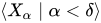

is defined to be
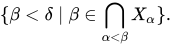
That is, an ordinal is in the diagonal intersection if and only if it is contained in the first members of the sequence. This is the same as


![{\displaystyle \displaystyle \bigcap _{\alpha <\delta }([0,\alpha ]\cup X_{\alpha }),}](https://wikimedia.org/api/rest_v1/media/math/render/svg/f6316e249339d97a2d13066c9d9f1d66a7b5259f)
where the closed interval from 0 to is used to avoid restricting the range of the intersection.

Relationship to the Nonstationary Ideal
For κ an uncountable regular cardinal, in the Boolean algebra P(κ)/INS where INS is the nonstationary ideal (the ideal dual to the club filter), the diagonal intersection of a κ-sized family of subsets of κ does not depend on the enumeration. That is to say, if one enumeration gives the diagonal intersection X1 and another gives X2, then there is a club C so that X1 ∩ C = X2 ∩ C.
A set Y is a lower bound of F in P(κ)/INS only when for any S ∈ F there is a club C so that Y ∩ C ⊆ S. The diagonal intersection ΔF of F plays the role of greatest lower bound of F, meaning that Y is a lower bound of F if and only if there is a club C so that Y ∩ C ⊆ ΔF.
This makes the algebra P(κ)/INS a κ+-complete Boolean algebra, when equipped with diagonal intersections.
See also
References
- Thomas Jech, Set Theory, The Third Millennium Edition, Springer-Verlag Berlin Heidelberg New York, 2003, page 92, 93.
- Akihiro Kanamori, The Higher Infinite, Second Edition, Springer-Verlag Berlin Heidelberg, 2009, page 2.
This article incorporates material from diagonal intersection on PlanetMath, which is licensed under the Creative Commons Attribution/Share-Alike License.
| General | |||||||||
|---|---|---|---|---|---|---|---|---|---|
| Theorems (list), paradoxes | |||||||||
| Logics |
| ||||||||
| Set theory |
| ||||||||
| Formal systems (list), language, syntax |
| ||||||||
| Proof theory | |||||||||
| Model theory | |||||||||
| Computability theory | |||||||||
| Related | |||||||||

| Overview |  | |
|---|---|---|
| Axioms | ||
| Operations |
| |
| ||
| Set types | ||
| Theories | ||
| ||
| Set theorists | ||
 | This mathematical logic–related article is a stub. You can help Wikipedia by adding missing information. |
Content Disclaimer
Informasi ini disarikan dari Wikipedia dan disajikan kembali untuk tujuan edukasi. Konten tersedia di bawah lisensi CC BY-SA 3.0. Kami tidak bertanggung jawab atas ketidakakuratan data yang bersumber dari kontribusi publik tersebut.
- The information displayed on this website is sourced in part or in whole from Wikipedia and has been adapted for the purpose of restating it. We strive to provide accurate and relevant information, however:
- There is no guarantee of absolute accuracy. Wikipedia is an open, collaborative project that can be edited by anyone, so information is subject to change.
- It is not intended to constitute professional advice. The content displayed is for informational and educational purposes only. For important decisions (e.g., medical, legal, or financial), please consult a professional.
- Content copyright. Wikipedia is licensed under the Creative Commons Attribution-ShareAlike License (CC BY-SA). This means that content may be reused with appropriate attribution and shared under a similar license.
- Responsible use. Any risk arising from the use of information from this website is entirely the responsibility of the user.