Desman
| Desmanini[1] Temporal range:
| |
|---|---|

| |
| Russian desman (Desmana moschata) | |
Scientific classification 
| |
| Kingdom: | Animalia |
| Phylum: | Chordata |
| Class: | Mammalia |
| Infraclass: | Placentalia |
| Order: | Eulipotyphla |
| Family: | Talpidae |
| Subfamily: | Talpinae |
| Tribe: | Desmanini Thomas, 1912 |
| Living genera | |
|
For fossil genera, see text | |

| |
Desmans are aquatic insectivores of the tribe Desmanini (also considered a subfamily, Desmaninae) in the mole family, Talpidae.
This tribe consists of two living species found in Europe: the Russian desman (Desmana moschata) in European Russia, and the Pyrenean desman (Galemys pyrenaicus) in the northwest of the Iberian Peninsula and the Pyrenees. Both species are endangered, the Russian desman critically so.[2][3] They have webbed paws and their front paws are not well-adapted for digging. Desmans were much more diverse and widespread during the Miocene, with two genera, Gaillardia and Magnatalpa, being present in North America.[4][5] Both living species are thought to have derived from the fossil genus Archaeodesmana.[6]
Species
- Genus Desmana
- Genus Galemys
- Pyrenean desman (G. pyrenaicus)
- Genus †Asthenoscapter Miocene, Europe[7]
- Genus †Archaeodesmana Miocene-Pliocene, Europe
- Genus †Desmanella Miocene, Europe[8][9]
- Genus †Gaillardia Miocene, North America
- Genus †Mygalinia Late Miocene, Hungary
- Genus †Magnatalpa Miocene-Pliocene, North America[5]
- Genus †Ruemkelia[10]
Gallery
-
 The bare snout of Galemys pyrenaicus
 -
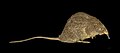
-


In the media
- Morelle, Rebecca (2012-09-04). "Pyrenean desman: On the trail of Europe's weirdest beast". BBC News Online. Retrieved 2012-09-05.
video report
- "Russians rally for water mammal". BBC News Online. 2006-06-09. Retrieved 2012-09-05.
References
- ^ Hutterer, R. (2005). Wilson, D.E.; Reeder, D.M. (eds.). Mammal Species of the World: A Taxonomic and Geographic Reference (3rd ed.). Johns Hopkins University Press. p. 303. ISBN 978-0-8018-8221-0. OCLC 62265494.
- ^ Quaglietta, L. (2022) [amended version of 2021 assessment]. "Galemys pyrenaicus". IUCN Red List of Threatened Species. 2022 e.T8826A214429993. doi:10.2305/IUCN.UK.2022-1.RLTS.T8826A214429993.en.
- ^ Rutovskaya, M.; Gazzard, A.; Turvey, S.T. (2023). "Desmana moschata". IUCN Red List of Threatened Species. 2023 e.T6506A231334630. doi:10.2305/IUCN.UK.2023-1.RLTS.T6506A231334630.en.
- ^ Martin, James E. (2017). "A rare occurrence of the fossil water mole Gaillardia (Desmanini, Talpidae) from the Neogene in North America" (PDF). Proceedings of the South Dakota Academy of Science. 96: 95–98.
- ^ a b c d e f g Oberg, Danielle; Samuels, Joshua (2022). "Fossil moles from the Gray Fossil Site (Tennessee): Implications for diversification and evolution of North American Talpidae". Palaeontologia Electronica. doi:10.26879/1150. S2CID 91857382.
- ^ Minwer-Barakat, Raef; García-Alix, Antonio; Martín-Suárez, Elvira; Freudenthal, Matthijs (2020-12-01). "Early Pliocene Desmaninae (Mammalia, Talpidae) from Southern Spain and the Origin of the Genus Desmana". Journal of Vertebrate Paleontology. 40 (5) e1835936. Bibcode:2020JVPal..40E5936M. doi:10.1080/02724634.2020.1835936. ISSN 0272-4634. S2CID 228905970.
- ^ Hutchison, John Howard (1974). "Notes on type specimens of European Miocene Talpidae and a tentative classification of old world Tertiary Talpidae (Insectivora: Mammalia)". Geobios. 7 (3): 211–256. Bibcode:1974Geobi...7..211H. doi:10.1016/s0016-6995(74)80009-4.
- ^ Meier, Patricia; Bickelmann, Constanze; Scheyer, Torsten; Koyabu, Daisuke; Sánchez-Villagra, Marcelo (2013). "Evolution of bone compactness in extant and extinct moles (Talpidae): exploring humeral microstructure in small fossorial mammals". BMC Evolutionary Biology. 13 (1): 55. Bibcode:2013BMCEE..13...55M. doi:10.1186/1471-2148-13-55. PMC 3599842. PMID 23442022.
- ^ "Palaeobiology Database: Desmanella stehlini".
- ^ Rzebik-Kowalska, Barbara; Pawłowski, Jerzy. "Ruemkelia (Mammalia, Insectivora, Talpidae) nom. nov. for Dibolia RÜMKE, 1985 (nec LATREILLE, 1829)". Acta Zoologica Cracoviensia.
Content Disclaimer
Informasi ini disarikan dari Wikipedia dan disajikan kembali untuk tujuan edukasi. Konten tersedia di bawah lisensi CC BY-SA 3.0. Kami tidak bertanggung jawab atas ketidakakuratan data yang bersumber dari kontribusi publik tersebut.
- The information displayed on this website is sourced in part or in whole from Wikipedia and has been adapted for the purpose of restating it. We strive to provide accurate and relevant information, however:
- There is no guarantee of absolute accuracy. Wikipedia is an open, collaborative project that can be edited by anyone, so information is subject to change.
- It is not intended to constitute professional advice. The content displayed is for informational and educational purposes only. For important decisions (e.g., medical, legal, or financial), please consult a professional.
- Content copyright. Wikipedia is licensed under the Creative Commons Attribution-ShareAlike License (CC BY-SA). This means that content may be reused with appropriate attribution and shared under a similar license.
- Responsible use. Any risk arising from the use of information from this website is entirely the responsibility of the user.