Deployable structure

A deployable structure is a structure that can change shape so as to significantly change its size.[1][2]
Examples of deployable structures are umbrellas, some tensegrity structures, bistable structures, some Origami shapes and scissor-like structures. Deployable structures are also used on spacecraft for deploying solar panels and solar sails.
Space-based deployable structures can be categorized into three primary classes: the first is the articulated structure class wherein rigid members contain sliding contact joints or are folded at hinge points and pivot to deploy, often locking into place. The second class consists of on-orbit assembly where a device is fabricated and/or mechanically joined in space to form the structure. The final class is high strain structures (often composed of High strain composites) wherein the device is dramatically flexed from one configuration to another during deployment.
Gallery
-
 Scissor-type structure
 -
 Multiple scissor-type structure
 -
 Simple Hoberman mechanism
 -
 Compound Hoberman mechanism
 -
 Outward folding deployable ring structure
 -
 Inward folding deployable ring structure
 -
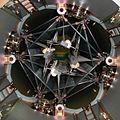 NuSTAR mast in the stowed configuration.
 -
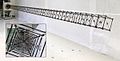 NuSTAR mast deployed.


See also
- Engineering mechanics
- Four-bar linkage
- Kinematics
- Linkage (mechanical)
- Machine
- Outline of machines
- Overconstrained mechanism
- Parallel motion
- Slider-crank linkage
- Compliant mechanism
References
External links
 Media related to Deployable structure at Wikimedia Commons
- University of Cambridge Deployable structures department publications

Content Disclaimer
Informasi ini disarikan dari Wikipedia dan disajikan kembali untuk tujuan edukasi. Konten tersedia di bawah lisensi CC BY-SA 3.0. Kami tidak bertanggung jawab atas ketidakakuratan data yang bersumber dari kontribusi publik tersebut.
- The information displayed on this website is sourced in part or in whole from Wikipedia and has been adapted for the purpose of restating it. We strive to provide accurate and relevant information, however:
- There is no guarantee of absolute accuracy. Wikipedia is an open, collaborative project that can be edited by anyone, so information is subject to change.
- It is not intended to constitute professional advice. The content displayed is for informational and educational purposes only. For important decisions (e.g., medical, legal, or financial), please consult a professional.
- Content copyright. Wikipedia is licensed under the Creative Commons Attribution-ShareAlike License (CC BY-SA). This means that content may be reused with appropriate attribution and shared under a similar license.
- Responsible use. Any risk arising from the use of information from this website is entirely the responsibility of the user.