Delivery reliability
 | This article needs additional citations for verification. (August 2025) |
Delivery reliability is concerned with the completeness and timeliness of delivery of goods which have been ordered. It is one of the five attributes in supply-chain management according to SCOR-model, developed by the management consulting firm PRTM, now part of PricewaterhouseCoopers LLP, (PwC) and endorsed by the Supply-Chain Council (SCC) as the cross-industry de facto standard diagnostic tool for supply chain management, SCOR measures the supplier’s ability to predictably complete processes as promised. It is measured by perfect order fulfillment and demonstrates the degree to which a supplier is able to serve its customers within the promised delivery time. Companies can apply the concept to the delivery of their incoming materials orders and their delivery of products to customers.[1]
Following the nomenclature of the DR-DP-Matrix, three main approaches to measure DR can be distinguished:
- (equivalent to confirmed line item performance, or CLIP)


- Type of measurement: volume (V)/singular(S)
- Type of view: on time (T)/ delivery (D)
Volume/on time
This measure is equivalent to confirmed line item performance (CLIP).
Formula
If ()

- =

Note: In the case where a supplier notifies the appropriate partner in the supply chain that a promised delivery date/quantity cannot be met, which is called delivery early warning (DEW), the sum of DEWs issued to reduce the commit for a certain week is added in the denominator.
Else
- NULL
Demand: Suppliers confirmed quantity; c: Product identifier;p: Time period e.g. a day, a week, a month ...
The cumulation over a period and a group of product identifiers c is done as follows:
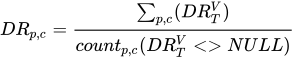
whereas p is determined by demand period.
Singular/delivery and singular/on Time
Singular case definition
To fit to the needs of the environment, the granularity of a singular case () has to be defined. In general a singular case is described by an n-Tuple consisting of a set of the following order and delivery details:

- order number
- customer identifier
- product identifier
- wish date of customer (the date when the customer wants the material to be in their facilities)
- confirmed date of supplier
- ship to information
- delivery date
- delivery note number
Formula
1)
- After a singular case has been delivered to the customer its DR is measured as follows:
- If (wish date <= arrival date <= confirmed date of supplier) then
- DRsingular case=1
- else
- DRsingular case=0
- If (wish date <= arrival date <= confirmed date of supplier) then
arrival date = delivery date + transit time
By cumulating the results of singular cases over a certain period p and, if necessary, additional criteria c (e.g. customer, product, ...) the delivery reliability is calculated as follows:
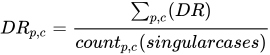
whereas p is determined by the arrival date.
2)
- After a period has elapsed all singular cases with first confirmed date within period are considered and their DR is measured as follows:
- If (wish date <= arrival date <= confirmed date of supplier) then
- DRsingular case=1
- else
- DRsingular case=0
- If (wish date <= arrival date <= confirmed date of supplier) then
arrival date = delivery date + transit time
By cumulating the results of singular cases over a certain period p and, if necessary, additional criteria c (e.g. customer, product, ...) the delivery reliability is calculated as follows:
whereas p is determined by the first confirmed date.
Result
0%≤≤100%

References
- ^ Heaney, B., Supply Chain Visibility and Segmentation: Control Tower Approach, p. 5, Aberdeen Group, published in July 2014
External links
Content Disclaimer
Informasi ini disarikan dari Wikipedia dan disajikan kembali untuk tujuan edukasi. Konten tersedia di bawah lisensi CC BY-SA 3.0. Kami tidak bertanggung jawab atas ketidakakuratan data yang bersumber dari kontribusi publik tersebut.
- The information displayed on this website is sourced in part or in whole from Wikipedia and has been adapted for the purpose of restating it. We strive to provide accurate and relevant information, however:
- There is no guarantee of absolute accuracy. Wikipedia is an open, collaborative project that can be edited by anyone, so information is subject to change.
- It is not intended to constitute professional advice. The content displayed is for informational and educational purposes only. For important decisions (e.g., medical, legal, or financial), please consult a professional.
- Content copyright. Wikipedia is licensed under the Creative Commons Attribution-ShareAlike License (CC BY-SA). This means that content may be reused with appropriate attribution and shared under a similar license.
- Responsible use. Any risk arising from the use of information from this website is entirely the responsibility of the user.