Decarya
| Decarya | |
|---|---|

| |
Scientific classification 
| |
| Kingdom: | Plantae |
| Clade: | Embryophytes |
| Clade: | Tracheophytes |
| Clade: | Spermatophytes |
| Clade: | Angiosperms |
| Clade: | Eudicots |
| Order: | Caryophyllales |
| Family: | Didiereaceae |
| Genus: | Decarya Choux (1929) |
| Species: | D. madagascariensis
|
| Binomial name | |
| Decarya madagascariensis Choux (1934)
| |
| Synonyms[2] | |
|
Alluaudia geayi Choux (1929), nom. nud. | |

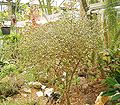
Decarya is a monotypic genus of flowering plants belonging to the family Didiereaceae.[3] It has one species, Decarya madagascariensis, a shrub or tree endemic to southern Madagascar.[2] It grows up to 6 meters in height, with zig-zagging branches covered in short spines.[1]

It is native to Atsimo-Andrefana, Androy, and Anosy regions of southern Madagascar, where it is found between Toliara and Tolagnaro. It grows in dry spiny thicket or forest and in degraded thicket on limestone, from sea level to 400 meters elevation. It often grows with species of Didierea and Euphorbia. The plant is threatened by habitat destruction from human-caused fires, land clearance for agriculture and pasture, and over-harvesting for charcoal production, and its population is thought to be declining. The IUCN Red List assesses the species as near-threatened.[1]
The species was first described and published in Mém. Acad. Natl. Sci. Lyon, Cl. Sci. Vol.17 page 62 in 1934.[2] The genus is named after Raymond Decary (1891–1973), French botanist, ethnologist and colonial administrator who conducted research in Madagascar and collected for the National Museum of Natural History, France.[4]
Gallery
-

-
 Decarya with Alluaudia procera and Delosperma bosseranum
 -

-
-


.jpg)


References
- ^ a b c Ramanantsialonina, R.N. 2019. Decarya madagascariensis. The IUCN Red List of Threatened Species 2019: e.T128095495A128098570. https://dx.doi.org/10.2305/IUCN.UK.2019-2.RLTS.T128095495A128098570.en. Retrieved 29 January 2025.
- ^ a b c "Decarya madagascariensis Choux | Plants of the World Online | Kew Science". Plants of the World Online. Retrieved 29 January 2025.
- ^ "Decarya Choux | Plants of the World Online | Kew Science". Plants of the World Online. Retrieved 14 May 2021.
- ^ Bayton, Ross (2020). The Gardener's Botanical: An Encyclopedia of Latin Plant Names. Princeton, New Jersey: Princeton University Press. ISBN 978-0-691-20017-0.
Content Disclaimer
Informasi ini disarikan dari Wikipedia dan disajikan kembali untuk tujuan edukasi. Konten tersedia di bawah lisensi CC BY-SA 3.0. Kami tidak bertanggung jawab atas ketidakakuratan data yang bersumber dari kontribusi publik tersebut.
- The information displayed on this website is sourced in part or in whole from Wikipedia and has been adapted for the purpose of restating it. We strive to provide accurate and relevant information, however:
- There is no guarantee of absolute accuracy. Wikipedia is an open, collaborative project that can be edited by anyone, so information is subject to change.
- It is not intended to constitute professional advice. The content displayed is for informational and educational purposes only. For important decisions (e.g., medical, legal, or financial), please consult a professional.
- Content copyright. Wikipedia is licensed under the Creative Commons Attribution-ShareAlike License (CC BY-SA). This means that content may be reused with appropriate attribution and shared under a similar license.
- Responsible use. Any risk arising from the use of information from this website is entirely the responsibility of the user.