Coxeter complex
In mathematics, the Coxeter complex, named after H. S. M. Coxeter, is a geometrical structure (a simplicial complex) associated to a Coxeter group. Coxeter complexes are the basic objects that allow the construction of buildings; they form the apartments of a building.
Construction
The canonical linear representation
The first ingredient in the construction of the Coxeter complex associated to a Coxeter system is a certain representation of , called the canonical representation of .


Let be a Coxeter system with Coxeter matrix . The canonical representation is given by a vector space with basis of formal symbols , which is equipped with the symmetric bilinear form . In particular, . The action of on is then given by .



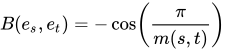
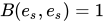

This representation has several foundational properties in the theory of Coxeter groups; for instance, is positive definite if and only if is finite. It is a faithful representation of .

Chambers and the Tits cone
This representation describes as a reflection group, with the caveat that might not be positive definite. It becomes important then to distinguish the representation from its dual . The vectors lie in and have corresponding dual vectors in given by



where the angled brackets indicate the natural pairing between and .
Now acts on and the action is given by

for and any . Then is a reflection in the hyperplane . One has the fundamental chamber ; this has faces the so-called walls, . The other chambers can be obtained from by translation: they are the for .






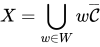
The Tits cone is . This need not be the whole of . Of major importance is the fact that is convex. The closure of is a fundamental domain for the action of on .


The Coxeter complex
The Coxeter complex of with respect to is , where is the multiplicative group of positive reals.




Examples
Finite dihedral groups
The dihedral groups (of order 2n) are Coxeter groups, of corresponding type . These have the presentation .



The canonical linear representation of is the usual reflection representation of the dihedral group, as acting on an -gon in the plane (so in this case). For instance, in the case we get the Coxeter group of type , acting on an equilateral triangle in the plane. Each reflection has an associated hyperplane in the dual vector space (which can be canonically identified with the vector space itself using the bilinear form , which is an inner product in this case as remarked above); these are the walls. They cut out chambers, as seen below:


The Coxeter complex is then the corresponding -gon, as in the image above. This is a simplicial complex of dimension 1, and it can be colored by cotype.

The infinite dihedral group
Another motivating example is the infinite dihedral group . This can be seen as the group of symmetries of the real line that preserves the set of points with integer coordinates; it is generated by the reflections in and . This group has the Coxeter presentation .


In this case, it is no longer possible to identify with its dual space , as is degenerate. It is then better to work solely with , which is where the hyperplanes are defined. This then gives the following picture:

In this case, the Tits cone is not the whole plane, but only the open upper half plane with the origin. Taking the quotient by the positive reals then yields another copy of the real line, with marked points at the integers. This is the Coxeter complex of the infinite dihedral group.
Alternative construction of the Coxeter complex
Another description of the Coxeter complex uses standard cosets of the Coxeter group . A standard coset is a coset of the form , where for some proper subset of . For instance, and .


The Coxeter complex is then the poset of standard cosets, ordered by reverse inclusion. This has a canonical structure of a simplicial complex, as do all posets that satisfy:
- Any two elements have a greatest lower bound.
- The poset of elements less than or equal to any given element is isomorphic to the poset of subsets of for some integer n.

Properties
The Coxeter complex associated to has dimension . It is homeomorphic to a -sphere if W is finite and is contractible if W is infinite.


Every apartment of a spherical Tits building is a Coxeter complex.[1]
See also
References
- ^ https://dept.math.lsa.umich.edu/~lji/building-curve-complex-handbook.pdf pg. 8, definition 2.5
Sources
- Peter Abramenko and Kenneth S. Brown, Buildings, Theory and Applications. Springer, 2008.
| International | |
|---|---|
| National | |
| Other | |

Content Disclaimer
Informasi ini disarikan dari Wikipedia dan disajikan kembali untuk tujuan edukasi. Konten tersedia di bawah lisensi CC BY-SA 3.0. Kami tidak bertanggung jawab atas ketidakakuratan data yang bersumber dari kontribusi publik tersebut.
- The information displayed on this website is sourced in part or in whole from Wikipedia and has been adapted for the purpose of restating it. We strive to provide accurate and relevant information, however:
- There is no guarantee of absolute accuracy. Wikipedia is an open, collaborative project that can be edited by anyone, so information is subject to change.
- It is not intended to constitute professional advice. The content displayed is for informational and educational purposes only. For important decisions (e.g., medical, legal, or financial), please consult a professional.
- Content copyright. Wikipedia is licensed under the Creative Commons Attribution-ShareAlike License (CC BY-SA). This means that content may be reused with appropriate attribution and shared under a similar license.
- Responsible use. Any risk arising from the use of information from this website is entirely the responsibility of the user.