Cornacchia's algorithm
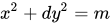
In computational number theory, Cornacchia's algorithm is an algorithm for solving the Diophantine equation , where and d and m are coprime. The algorithm was described in 1908 by Giuseppe Cornacchia.[1]

The algorithm
First, one finds any solution to ; if no such exist, there can be no primitive solution to the original equation. Without loss of generality, one can assume that r0 ≤ m/2 (if not, then replace r0 with m - r0, which will still be a root of -d). Then the Euclidean algorithm can be employed to find , and so on; stopping when . If is an integer, then the solution is ; otherwise try another root of -d until either a solution is found or all roots have been exhausted. In this case there is no primitive solution.







This algorithm can also be used to find non-primitive solutions (x, y) where gcd(x, y) = g ≠ 1, because the existence of such a solution implies that g2 divides m (and equivalently, that if m is square-free, then all solutions are primitive). Thus the above algorithm can be used to search for a primitive solution (u, v) to u2 + dv2 = m/g2. If such a solution is found, then (gu, gv) will be a solution to the original equation.
Example
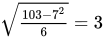
Solve the equation . A square root of −6 (mod 103) is 32, and 103 ≡ 7 (mod 32); since and , there is a solution x = 7, y = 3.


References
- ^ Cornacchia, G. (1908). "Su di un metodo per la risoluzione in numeri interi dell' equazione ". Giornale di Matematiche di Battaglini. 46: 33–90.
External links
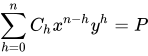
- Basilla, J. M. (2004). "On the solutions of " (PDF). Proc. Japan Acad. 80(A): 40–41. doi:10.3792/pjaa.80.40.
Content Disclaimer
Informasi ini disarikan dari Wikipedia dan disajikan kembali untuk tujuan edukasi. Konten tersedia di bawah lisensi CC BY-SA 3.0. Kami tidak bertanggung jawab atas ketidakakuratan data yang bersumber dari kontribusi publik tersebut.
- The information displayed on this website is sourced in part or in whole from Wikipedia and has been adapted for the purpose of restating it. We strive to provide accurate and relevant information, however:
- There is no guarantee of absolute accuracy. Wikipedia is an open, collaborative project that can be edited by anyone, so information is subject to change.
- It is not intended to constitute professional advice. The content displayed is for informational and educational purposes only. For important decisions (e.g., medical, legal, or financial), please consult a professional.
- Content copyright. Wikipedia is licensed under the Creative Commons Attribution-ShareAlike License (CC BY-SA). This means that content may be reused with appropriate attribution and shared under a similar license.
- Responsible use. Any risk arising from the use of information from this website is entirely the responsibility of the user.