Control variates
The control variates method is a variance reduction technique used in Monte Carlo methods. It exploits information about the errors in estimates of known quantities to reduce the error of an estimate of an unknown quantity.[1] [2][3]
Underlying principle
Let the unknown parameter of interest be , and assume we have a statistic such that the expected value of m is μ: , i.e. m is an unbiased estimator for μ. Suppose we calculate another statistic such that is a known value. Then


![{\displaystyle \mathbb {E} \left[m\right]=\mu }](https://wikimedia.org/api/rest_v1/media/math/render/svg/a20f602ef5e52ccac3808a48f0a14c600b36fb1c)

![{\displaystyle \mathbb {E} \left[t\right]=\tau }](https://wikimedia.org/api/rest_v1/media/math/render/svg/1903b64e792a1455fedd92d54d668fa9a23a5967)

is also an unbiased estimator for for any choice of the coefficient . The variance of the resulting estimator is



By differentiating the above expression with respect to , it can be shown that choosing the optimal coefficient
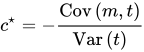
minimizes the variance of . (Note that this coefficient is the same as the coefficient obtained from a linear regression.) With this choice,
![{\displaystyle {\begin{aligned}{\textrm {Var}}\left(m^{\star }\right)&={\textrm {Var}}\left(m\right)-{\frac {\left[{\textrm {Cov}}\left(m,t\right)\right]^{2}}{{\textrm {Var}}\left(t\right)}}\\&=\left(1-\rho _{m,t}^{2}\right){\textrm {Var}}\left(m\right)\end{aligned}}}](https://wikimedia.org/api/rest_v1/media/math/render/svg/3399b00e688aae740a79cd98214602547b8f7b51)
where

is the correlation coefficient of and . The greater the value of , the greater the variance reduction achieved.

In the case that , , and/or are unknown, they can be estimated across the Monte Carlo replicates. This is equivalent to solving a certain least squares system; therefore this technique is also known as regression sampling.


When the expectation of the control variable, , is not known analytically, it is still possible to increase the precision in estimating (for a given fixed simulation budget), provided that the two conditions are met: 1) evaluating is significantly cheaper than computing ; 2) the magnitude of the correlation coefficient is close to unity. [3]

Example
We would like to estimate
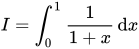
using Monte Carlo integration. This integral is the expected value of , where

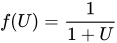
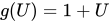
and U follows a uniform distribution [0, 1]. Using a sample of size n denote the points in the sample as . Then the estimate is given by

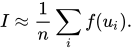
Now we introduce as a control variate with a known expected value and combine the two into a new estimate
![{\displaystyle \mathbb {E} \left[g\left(U\right)\right]=\int _{0}^{1}(1+x)\,\mathrm {d} x={\tfrac {3}{2}}}](https://wikimedia.org/api/rest_v1/media/math/render/svg/63e77fbb5d0fec9232e81a7b53bfada99a2cee8e)

Using realizations and an estimated optimal coefficient we obtain the following results


| Estimate | Variance | |
| Classical estimate | 0.69475 | 0.01947 |
| Control variates | 0.69295 | 0.00060 |
The variance was significantly reduced after using the control variates technique. (The exact result is .)

See also
 | This article needs additional citations for verification. (August 2011) |
Notes
- ^ Lemieux, C. (2017). "Control Variates". Wiley StatsRef: Statistics Reference Online. pp. 1–8. doi:10.1002/9781118445112.stat07947. ISBN 9781118445112.
- ^ Glasserman, P. (2004). Monte Carlo Methods in Financial Engineering. New York: Springer. ISBN 0-387-00451-3 (p. 185)
- ^ a b Botev, Z.; Ridder, A. (2017). "Variance Reduction". Wiley StatsRef: Statistics Reference Online. pp. 1–6. doi:10.1002/9781118445112.stat07975. hdl:1959.4/unsworks_50616. ISBN 9781118445112.
References
- Ross, Sheldon M. (2002) Simulation 3rd edition ISBN 978-0-12-598053-1
- Averill M. Law & W. David Kelton (2000), Simulation Modeling and Analysis, 3rd edition. ISBN 0-07-116537-1
- S. P. Meyn (2007) Control Techniques for Complex Networks, Cambridge University Press. ISBN 978-0-521-88441-9. Downloadable draft (Section 11.4: Control variates and shadow functions)
Content Disclaimer
Informasi ini disarikan dari Wikipedia dan disajikan kembali untuk tujuan edukasi. Konten tersedia di bawah lisensi CC BY-SA 3.0. Kami tidak bertanggung jawab atas ketidakakuratan data yang bersumber dari kontribusi publik tersebut.
- The information displayed on this website is sourced in part or in whole from Wikipedia and has been adapted for the purpose of restating it. We strive to provide accurate and relevant information, however:
- There is no guarantee of absolute accuracy. Wikipedia is an open, collaborative project that can be edited by anyone, so information is subject to change.
- It is not intended to constitute professional advice. The content displayed is for informational and educational purposes only. For important decisions (e.g., medical, legal, or financial), please consult a professional.
- Content copyright. Wikipedia is licensed under the Creative Commons Attribution-ShareAlike License (CC BY-SA). This means that content may be reused with appropriate attribution and shared under a similar license.
- Responsible use. Any risk arising from the use of information from this website is entirely the responsibility of the user.