Complex squaring map
In mathematics, the complex squaring map, a polynomial mapping of degree two, is a simple and accessible demonstration of chaos in dynamical systems. It can be constructed by performing the following steps:
- Choose any complex number on the unit circle whose argument (angle) is not a rational multiple of π,
- Repeatedly square that number.
This repetition (iteration) produces a sequence of complex numbers that can be described alone by their arguments. Any choice of starting angle that satisfies (1) above will produce an extremely complicated sequence of angles, that belies the simplicity of the steps. It can be shown that the sequence will be chaotic, i.e. it is sensitive to the detailed choice of starting angle.
Chaos and the complex squaring map
The informal reason why the iteration is chaotic is that the angle doubles on every iteration and doubling grows very quickly as the angle becomes ever larger, but angles which differ by multiples of 2π (radians) are identical. Thus, when the angle exceeds 2π, it must wrap to the remainder on division by 2π. Therefore, the angle is transformed according to the dyadic transformation (also known as the 2x mod 1 map). As the initial value z0 has been chosen so that its argument is not a rational multiple of π, the forward orbit of zn cannot repeat itself and become periodic.
More formally, the iteration can be written as

where is the resulting sequence of complex numbers obtained by iterating the steps above, and represents the initial starting number. We can solve this iteration exactly:


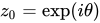
Starting with angle θ, we can write the initial term as so that . This makes the successive doubling of the angle clear. (This is equivalent to the relation by Euler's formula.)


Generalisations
This map is a special case of the complex quadratic map, which has exact solutions for many special cases.[1] The complex map obtained by raising the previous number to any natural number power is also exactly solvable as . In the case p = 2, the dynamics can be mapped to the dyadic transformation, as described above, but for p > 2, we obtain a shift map in the number base p. For example, p = 10 is a decimal shift map.


See also
References
- ^ M. Little, D. Heesch (2004), Chaotic root-finding for a small class of polynomials, Journal of Difference Equations and Applications, 10(11):949–953.


Content Disclaimer
Informasi ini disarikan dari Wikipedia dan disajikan kembali untuk tujuan edukasi. Konten tersedia di bawah lisensi CC BY-SA 3.0. Kami tidak bertanggung jawab atas ketidakakuratan data yang bersumber dari kontribusi publik tersebut.
- The information displayed on this website is sourced in part or in whole from Wikipedia and has been adapted for the purpose of restating it. We strive to provide accurate and relevant information, however:
- There is no guarantee of absolute accuracy. Wikipedia is an open, collaborative project that can be edited by anyone, so information is subject to change.
- It is not intended to constitute professional advice. The content displayed is for informational and educational purposes only. For important decisions (e.g., medical, legal, or financial), please consult a professional.
- Content copyright. Wikipedia is licensed under the Creative Commons Attribution-ShareAlike License (CC BY-SA). This means that content may be reused with appropriate attribution and shared under a similar license.
- Responsible use. Any risk arising from the use of information from this website is entirely the responsibility of the user.