Coding gain
 | This article has multiple issues. Please help improve it or discuss these issues on the talk page. (Learn how and when to remove these messages)
|


In coding theory, telecommunications engineering and other related engineering problems, coding gain is the measure in the difference between the signal-to-noise ratio (SNR) levels between the uncoded system and coded system required to reach the same bit error rate (BER) levels when used with the error correcting code (ECC).
Example
If the uncoded BPSK system in AWGN environment has a bit error rate (BER) of 10−2 at the SNR level 4 dB, and the corresponding coded (e.g., BCH) system has the same BER at an SNR of 2.5 dB, then we say the coding gain = 4 dB − 2.5 dB = 1.5 dB, due to the code used (in this case BCH).
Power-limited regime
In the power-limited regime (where the nominal spectral efficiency [b/2D or b/s/Hz], i.e. the domain of binary signaling), the effective coding gain of a signal set at a given target error probability per bit is defined as the difference in dB between the required to achieve the target with and the required to achieve the target with 2-PAM or (2×2)-QAM (i.e. no coding). The nominal coding gain is defined as


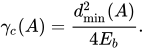
This definition is normalized so that for 2-PAM or (2×2)-QAM. If the average number of nearest neighbors per transmitted bit is equal to one, the effective coding gain is approximately equal to the nominal coding gain . However, if , the effective coding gain is less than the nominal coding gain by an amount which depends on the steepness of the vs. curve at the target . This curve can be plotted using the union bound estimate (UBE)


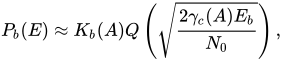
where Q is the Gaussian probability-of-error function.
For the special case of a binary linear block code with parameters , the nominal spectral efficiency is and the nominal coding gain is kd/n.


Example
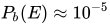
The table below lists the nominal spectral efficiency, nominal coding gain and effective coding gain at for Reed–Muller codes of length :

| Code | (dB) | (dB) | |||
|---|---|---|---|---|---|
| [8,7,2] | 1.75 | 7/4 | 2.43 | 4 | 2.0 |
| [8,4,4] | 1.0 | 2 | 3.01 | 4 | 2.6 |
| [16,15,2] | 1.88 | 15/8 | 2.73 | 8 | 2.1 |
| [16,11,4] | 1.38 | 11/4 | 4.39 | 13 | 3.7 |
| [16,5,8] | 0.63 | 5/2 | 3.98 | 6 | 3.5 |
| [32,31,2] | 1.94 | 31/16 | 2.87 | 16 | 2.1 |
| [32,26,4] | 1.63 | 13/4 | 5.12 | 48 | 4.0 |
| [32,16,8] | 1.00 | 4 | 6.02 | 39 | 4.9 |
| [32,6,16] | 0.37 | 3 | 4.77 | 10 | 4.2 |
| [64,63,2] | 1.97 | 63/32 | 2.94 | 32 | 1.9 |
| [64,57,4] | 1.78 | 57/16 | 5.52 | 183 | 4.0 |
| [64,42,8] | 1.31 | 21/4 | 7.20 | 266 | 5.6 |
| [64,22,16] | 0.69 | 11/2 | 7.40 | 118 | 6.0 |
| [64,7,32] | 0.22 | 7/2 | 5.44 | 18 | 4.6 |


Bandwidth-limited regime
In the bandwidth-limited regime (, i.e. the domain of non-binary signaling), the effective coding gain of a signal set at a given target error rate is defined as the difference in dB between the required to achieve the target with and the required to achieve the target with M-PAM or (M×M)-QAM (i.e. no coding). The nominal coding gain is defined as


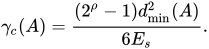
This definition is normalized so that for M-PAM or (M×M)-QAM. The UBE becomes

where is the average number of nearest neighbors per two dimensions.

See also
References
MIT OpenCourseWare, 6.451 Principles of Digital Communication II, Lecture Notes sections 5.3, 5.5, 6.3, 6.4
Content Disclaimer
Informasi ini disarikan dari Wikipedia dan disajikan kembali untuk tujuan edukasi. Konten tersedia di bawah lisensi CC BY-SA 3.0. Kami tidak bertanggung jawab atas ketidakakuratan data yang bersumber dari kontribusi publik tersebut.
- The information displayed on this website is sourced in part or in whole from Wikipedia and has been adapted for the purpose of restating it. We strive to provide accurate and relevant information, however:
- There is no guarantee of absolute accuracy. Wikipedia is an open, collaborative project that can be edited by anyone, so information is subject to change.
- It is not intended to constitute professional advice. The content displayed is for informational and educational purposes only. For important decisions (e.g., medical, legal, or financial), please consult a professional.
- Content copyright. Wikipedia is licensed under the Creative Commons Attribution-ShareAlike License (CC BY-SA). This means that content may be reused with appropriate attribution and shared under a similar license.
- Responsible use. Any risk arising from the use of information from this website is entirely the responsibility of the user.