Clay modeling
 | This article needs additional citations for verification. (May 2024) |
.jpg)
.jpg)
Clay modeling (or clay model making) for automobile prototypes was first introduced in the 1930s by automobile designer Harley Earl, head of the General Motors styling studio (known initially as the Art and Color Section, and later as the Design and Styling Department).[1]
The design method prior had used wood and metal, a process that required more time.[2]
Clay modeling is adopted throughout the industry and remains in use today, with designers and modelers using this method to refine their ideas, and for leadership for decision making, with high levels of confidentiality.[3][4]
Industrial plasticine or "clay" used for this purpose, is a material that can be easily shaped, thus enabling designers to create models to visualize a product.[5][6]
-
 Clay model seen in Zagato design studio (2009)
 -
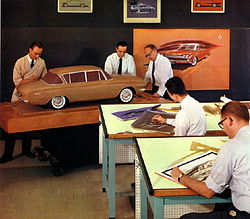 AMC designers with clay model (1961)


References
- ^ An Introduction to Modern Vehicle Design. United Kingdom: Elsevier Science & Technology Books. 2001. pp. 103–107. Retrieved 2024-08-23 – via Google Books.
- ^ Culmer, Kris (28 February 2025). "The story behind clay modelling - and why it's still used today | Autocar". www.autocar.co.uk. Retrieved 12 February 2026.
- ^ "A Soul of Clay". volvocars.com. 10 November 2025. Retrieved 13 February 2026.
- ^ "#7 Kazushi Eto, a master of clay modeling (Part 1)". Toyota Times. 17 January 2022. Retrieved 13 February 2026.
- ^ "Icon: Clay Art | Porsche Christophorus". Porsche Christophorus. Archived from the original on 2025-12-05. Retrieved 2026-02-13.
- ^ "Hidden figures of design: car sculptors". Škoda Storyboard. 4 January 2022. Retrieved 13 February 2026.
External links

.JPG) | This article about an automotive technology is a stub. You can help Wikipedia by adding missing information. |
Content Disclaimer
Informasi ini disarikan dari Wikipedia dan disajikan kembali untuk tujuan edukasi. Konten tersedia di bawah lisensi CC BY-SA 3.0. Kami tidak bertanggung jawab atas ketidakakuratan data yang bersumber dari kontribusi publik tersebut.
- The information displayed on this website is sourced in part or in whole from Wikipedia and has been adapted for the purpose of restating it. We strive to provide accurate and relevant information, however:
- There is no guarantee of absolute accuracy. Wikipedia is an open, collaborative project that can be edited by anyone, so information is subject to change.
- It is not intended to constitute professional advice. The content displayed is for informational and educational purposes only. For important decisions (e.g., medical, legal, or financial), please consult a professional.
- Content copyright. Wikipedia is licensed under the Creative Commons Attribution-ShareAlike License (CC BY-SA). This means that content may be reused with appropriate attribution and shared under a similar license.
- Responsible use. Any risk arising from the use of information from this website is entirely the responsibility of the user.