Chudnovsky algorithm
The Chudnovsky algorithm is a fast method for calculating the digits of π, based on Ramanujan's π formulae. Published by the Chudnovsky brothers in 1988,[1] it was used to calculate π to a billion decimal places.[2]
It was used in the world record calculations of approx. 2.7 trillion digits of π in December 2009,[3] 10 trillion digits in October 2011,[4][5] around 22.4 trillion digits in November 2016,[6] 31.4 trillion digits in September 2018–January 2019,[7] 50 trillion digits on January 29, 2020,[8] 62.8 trillion digits on August 14, 2021,[9] 100 trillion digits on March 21, 2022,[10] 105 trillion digits on March 14, 2024,[11] and 202 trillion digits on June 28, 2024.[12] Recently, the record was broken yet again on November 18, 2025 with 314 trillion digits of pi.[13][14] This was done through the usage of the algorithm on y-cruncher.
Algorithm
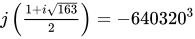
The algorithm is based on the negated Heegner number , the j-function , and on the following rapidly convergent generalized hypergeometric series:[15]


This identity is similar to some of Ramanujan's formulas involving π,[15] and is an example of a Ramanujan–Sato series.
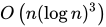
The time complexity of the algorithm is , where n is the number of digits desired.[16] Each term produces around 14 correct decimal digits of π.[17]
Optimizations
The optimization technique used for the world record computations is called binary splitting.[18]
See also

References
- ^ Chudnovsky, David; Chudnovsky, Gregory (1988), Approximation and complex multiplication according to Ramanujan, Ramanujan revisited: proceedings of the centenary conference
- ^ Warsi, Karl; Dangerfield, Jan; Farndon, John; Griffiths, Johny; Jackson, Tom; Patel, Mukul; Pope, Sue; Parker, Matt (2019). The Math Book: Big Ideas Simply Explained. New York: Dorling Kindersley Limited. p. 65. ISBN 978-1-4654-8024-8.
- ^ Baruah, Nayandeep Deka; Berndt, Bruce C.; Chan, Heng Huat (2009-08-01). "Ramanujan's Series for 1/π: A Survey". American Mathematical Monthly. 116 (7): 567–587. doi:10.4169/193009709X458555.
- ^ Yee, Alexander; Kondo, Shigeru (2011), 10 Trillion Digits of Pi: A Case Study of summing Hypergeometric Series to high precision on Multicore Systems, Technical Report, Computer Science Department, University of Illinois, hdl:2142/28348
- ^ Aron, Jacob (March 14, 2012), "Constants clash on pi day", New Scientist
- ^ "22.4 Trillion Digits of Pi". www.numberworld.org.
- ^ "Google Cloud Topples the Pi Record". www.numberworld.org/.
- ^ "The Pi Record Returns to the Personal Computer". www.numberworld.org/.
- ^ "Pi-Challenge - Weltrekordversuch der FH Graubünden - FH Graubünden". www.fhgr.ch. Retrieved 2021-08-17.
- ^ "Calculating 100 trillion digits of pi on Google Cloud". cloud.google.com. Retrieved 2022-06-10.
- ^ Yee, Alexander J. (2024-03-14). "Limping to a new Pi Record of 105 Trillion Digits". NumberWorld.org. Retrieved 2024-03-16.
- ^ Ranous, Jordan (2024-06-28). "StorageReview Lab Breaks Pi Calculation World Record with Over 202 Trillion Digits". StorageReview.com. Retrieved 2024-07-20.
- ^ "StorageReview Sets New Pi Record: 314 Trillion Digits on a Dell PowerEdge R7725". StorageReview.com. Retrieved 2026-01-02.
- ^ OBrien, Kevin (2025-12-25). "Pi calculation world record shattered at 314 trillion digits with a four-month run on a single server — StorageReview retakes the crown, thanks to storage bandwidth". Tom's Hardware. Retrieved 2026-01-02.
- ^ a b Baruah, Nayandeep Deka; Berndt, Bruce C.; Chan, Heng Huat (2009), "Ramanujan's series for 1/π: a survey", American Mathematical Monthly, 116 (7): 567–587, doi:10.4169/193009709X458555, JSTOR 40391165, MR 2549375
- ^ "y-cruncher - Formulas". www.numberworld.org. Retrieved 2018-02-25.
- ^ The limiting ratio between two consecutive terms, using Stirling's approximation, is ; and .
- ^ Brent, Richard P.; Zimmermann, Paul (2010). Modern Computer Arithmetic. Vol. 18. Cambridge University Press. doi:10.1017/CBO9780511921698. ISBN 978-0-511-92169-8.


Content Disclaimer
Informasi ini disarikan dari Wikipedia dan disajikan kembali untuk tujuan edukasi. Konten tersedia di bawah lisensi CC BY-SA 3.0. Kami tidak bertanggung jawab atas ketidakakuratan data yang bersumber dari kontribusi publik tersebut.
- The information displayed on this website is sourced in part or in whole from Wikipedia and has been adapted for the purpose of restating it. We strive to provide accurate and relevant information, however:
- There is no guarantee of absolute accuracy. Wikipedia is an open, collaborative project that can be edited by anyone, so information is subject to change.
- It is not intended to constitute professional advice. The content displayed is for informational and educational purposes only. For important decisions (e.g., medical, legal, or financial), please consult a professional.
- Content copyright. Wikipedia is licensed under the Creative Commons Attribution-ShareAlike License (CC BY-SA). This means that content may be reused with appropriate attribution and shared under a similar license.
- Responsible use. Any risk arising from the use of information from this website is entirely the responsibility of the user.