Censor bars
Censor bars, also known as black bars, are a form of text, photography, or video censorship in which sensitive content is occluded by rectangular monochrome boxes.[1][2] Since the creation of digital editing software which can apply less obtrusive effects such as pixelization and blurring, censor bars are typically used for satire.[3][4] but remain in use to address privacy concerns. Censor bars are also used in art forms such as blackout poetry.
Censor bars may also have the words "censored", "redacted", "private information", "sensitive information", etc. to indicate their presence. Alternative methods of obscuring content include overlaid images such as fig leaves.
Illustrations of usage
-
 A 1965 Federal Bureau of Investigation surveillance photograph
 -
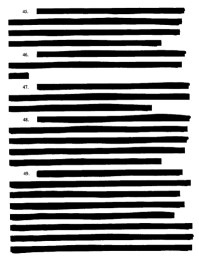 A heavily redacted page from the lawsuit American Civil Liberties Union v. Ashcroft
 -
 The censor bar as used by Google in the SOPA and PIPA online protests
 -

-
 Censor bars applied to a model
 -
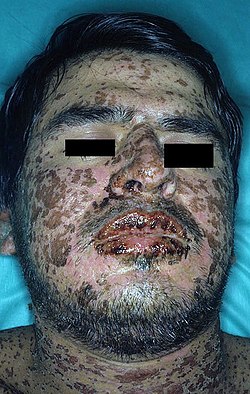 Censor bars applied to a patient with Stevens–Johnson syndrome
 -
 Censor bars used to anonymise a woman with familial dysautonomia
 -
 The Turkish Wikipedia logo with a censor bar covering the text, used from April 2017 to January 2020 when Turkish authorities blocked online access to Wikipedia in all languages across Turkey
 -
 A portion of the redacted affidavit used to obtain a search warrant for former U.S. President Donald Trump's Mar-a-Lago home and resort, with the signature block blacked out
.png)


.jpg)


See also

- Bleep censor
- Colour banding
- Fogging (censorship), an alternate technique
- Tape delay (broadcasting)
- Fig leaf - Artistic or metaphorical censorship practice
- Redaction (also known as sanitization) — the process of removing sensitive information from a document before distribution to a broader audience
- Full Block — A Unicode character commonly used for redaction.
References
- ^ The Purple Decades: A Reader, Tom Wolfe, p. 78
- ^ Context Providers: Conditions of Meaning in Media Arts, Margot Lovejoy & Christiane Paul & Victoria Vesna [1]
- ^ Banned in the media: a reference guide to censorship in the press, motion pictures, broadcasting, and the internet, Herbert N. Foerstel, p. 208 [2]
- ^ Click: The Forces Behind How We Fully Engage with People, Work, and Everything We Do, Ori Brafman & Rom Brafman, p.108 [3]
External links

 | This human rights–related article is a stub. You can help Wikipedia by adding missing information. |
 | This pornography-related article is a stub. You can help Wikipedia by adding missing information. |
Content Disclaimer
Informasi ini disarikan dari Wikipedia dan disajikan kembali untuk tujuan edukasi. Konten tersedia di bawah lisensi CC BY-SA 3.0. Kami tidak bertanggung jawab atas ketidakakuratan data yang bersumber dari kontribusi publik tersebut.
- The information displayed on this website is sourced in part or in whole from Wikipedia and has been adapted for the purpose of restating it. We strive to provide accurate and relevant information, however:
- There is no guarantee of absolute accuracy. Wikipedia is an open, collaborative project that can be edited by anyone, so information is subject to change.
- It is not intended to constitute professional advice. The content displayed is for informational and educational purposes only. For important decisions (e.g., medical, legal, or financial), please consult a professional.
- Content copyright. Wikipedia is licensed under the Creative Commons Attribution-ShareAlike License (CC BY-SA). This means that content may be reused with appropriate attribution and shared under a similar license.
- Responsible use. Any risk arising from the use of information from this website is entirely the responsibility of the user.