Callidulidae
| Callidulidae | |
|---|---|

| |
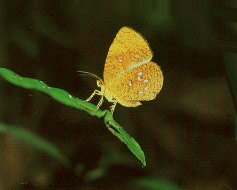
| A callidulid moth Tetragonus catamitus laying eggs on a fern in the Western Ghats. | |
Scientific classification 
| |
| Kingdom: | Animalia |
| Phylum: | Arthropoda |
| Clade: | Pancrustacea |
| Class: | Insecta |
| Order: | Lepidoptera |
| Clade: | Eulepidoptera |
| Clade: | Ditrysia |
| Clade: | Apoditrysia |
| Clade: | Obtectomera |
| Superfamily: | Calliduloidea |
| Family: | Callidulidae Moore, 1877 |
| Subfamilies and genera | |
|
Pterothysaninae Minet 1987 Griveaudiinae Minet, 1990 | |
| Diversity | |
| About 60 species | |
Callidulidae, the only known family of the superfamily Calliduloidea, is the family of Old World butterfly-moths, containing eight genera. They have a peculiar distribution, restricted to the Old World tropics of Southeast Asia to Australasia and Madagascar. The three subfamilies exhibit both day- and night-flying behaviour.
The mainly day-flying Callidulinae can be distinguished by their resting posture, which is the most butterfly-like, with the wings held closely over the back. Resembling the butterfly family Lycaenidae, these moths can be told apart by their antennae which taper to a point or may be very subtly clubbed. The more often night-flying Pterothysaninae and Griveaudiinae have a different adult resting posture (the latter roof-like in repose) and these were not placed within the Callidulidae until recently.[1]
Biology of most subfamilies and species is poorly known. Eggs are very flat in Griveaudiinae and Callidulinae, and caterpillars of Callidulinae are green with a shiny black head and have only been reported from ferns[2] forming a leaf roll in which they live, eat and finally pupate, while the pupa of Helicomitra appears to be subterranean.[3]
The closest relatives of Callidulidae are not known, but they are currently placed in a group that includes the three butterfly superfamilies, the "hook-tip moths" Drepanoidea and the "geometer moths" Geometroidea and also possibly Axioidea which share some structural characteristics.[4]
Cited references
- ^ Minet, J. (1986). Ébauche d'une classification moderne de l'ordre des Lépidoptères. Alexanor 14(7): 291–313.
- ^ Gaden S. Robinson, Phillip R. Ackery, Ian J. Kitching, George W. Beccaloni & Luis M. Hernández. HOSTS database. [1] (Accessed May 2007)
- ^ Minet, J. (1987). Description d'une chrysalide de Pterothysaninae (Lep. Callidulidae). Nouvelle Revue d'Entomologie (N.S.) 4(3): 312.
- ^ Minet, J. (1999 [1988]). The Axioidea and Calliduloidea. Ch. 16, pp. 257–261 in Kristensen, N.P. (Ed.). Lepidoptera, Moths and Butterflies. Volume 1: Evolution, Systematics, and Biogeography. Handbuch der Zoologie. Eine Naturgeschichte der Stämme des Tierreiches / Handbook of Zoology. A Natural History of the phyla of the Animal Kingdom. Band / Volume IV Arthropoda: Insecta Teilband / Part 35: 491 pp. Walter de Gruyter, Berlin, New York.
Other references
- Minet, J. (1990 [1989]). Nouvelles frontières, géographiques et taxonomiques, pour la famille des Callidulidae (Lepidoptera, Calliduloidea). Nouvelle Revue d'Entomologie (N.S.) 6(4): 351–368.
- Maddison, David R. 2003. Callidulidae. [2] in The Tree of Life Web Project, [3] Accessed October 2006
- O'Toole, Christopher (Ed.) (2002) Firefly Encyclopedia of Insects and Spiders. ISBN 1-55297-612-2
External links
- Tree of Life
- Natural History Museum hosts database
- LepIndex list of species and genera in superfamily Calliduloidea
- Moths of Borneo Callidulidae
- Moths of Borneo Callidulinae images
- Callidulinae species
- Callidula attenuata Accessed 4 March 2007
- Photo illustrating rest position


Content Disclaimer
Informasi ini disarikan dari Wikipedia dan disajikan kembali untuk tujuan edukasi. Konten tersedia di bawah lisensi CC BY-SA 3.0. Kami tidak bertanggung jawab atas ketidakakuratan data yang bersumber dari kontribusi publik tersebut.
- The information displayed on this website is sourced in part or in whole from Wikipedia and has been adapted for the purpose of restating it. We strive to provide accurate and relevant information, however:
- There is no guarantee of absolute accuracy. Wikipedia is an open, collaborative project that can be edited by anyone, so information is subject to change.
- It is not intended to constitute professional advice. The content displayed is for informational and educational purposes only. For important decisions (e.g., medical, legal, or financial), please consult a professional.
- Content copyright. Wikipedia is licensed under the Creative Commons Attribution-ShareAlike License (CC BY-SA). This means that content may be reused with appropriate attribution and shared under a similar license.
- Responsible use. Any risk arising from the use of information from this website is entirely the responsibility of the user.