CGHS model
The Callan–Giddings–Harvey–Strominger (CGHS) model is a toy model of general relativity in 1 spatial and 1 time dimension. It is named after Curtis Callan, Steven Giddings, Jeffrey A. Harvey and Andrew Strominger, who published on it in 1992.[1]
Overview
General relativity is a highly nonlinear model, and as such, its 3+1D version is usually too complicated to analyze in detail. In 3+1D and higher, propagating gravitational waves exist, but not in 2+1D or 1+1D. In 2+1D, general relativity becomes a topological field theory with no local degrees of freedom, and all 1+1D models are locally flat. However, a slightly more complicated generalization of general relativity which includes dilatons will turn the 2+1D model into one admitting mixed propagating dilaton-gravity waves, as well as making the 1+1D model geometrically nontrivial locally.[2][3] The 1+1D model still does not admit any propagating gravitational (or dilaton) degrees of freedom, but with the addition of matter fields, it becomes a simplified, but still nontrivial model. With other numbers of dimensions, a dilaton-gravity coupling can always be rescaled away by a conformal rescaling of the metric, converting the Jordan frame to the Einstein frame. But not in two dimensions, because the conformal weight of the dilaton is now 0. The metric in this case is more amenable to analytical solutions than the general 3+1D case. And of course, 0+1D models cannot capture any nontrivial aspect of relativity because there is no space at all.
This class of models retains just enough complexity to include among its solutions black holes, their formation, FRW cosmological models, gravitational singularities, etc. In the quantized version of such models with matter fields, Hawking radiation also shows up, just as in higher-dimensional models.
Action
A very specific choice of couplings and interactions leads to the CGHS model.
![{\displaystyle S={\frac {1}{2\pi }}\int d^{2}x\,{\sqrt {-g}}\left\{e^{-2\phi }\left[R+4\left(\nabla \phi \right)^{2}+4\lambda ^{2}\right]-\sum _{i=1}^{N}{\frac {1}{2}}\left(\nabla f_{i}\right)^{2}\right\}}](https://wikimedia.org/api/rest_v1/media/math/render/svg/4f5c7279430f972f668071517d19ddd9a9289894)
where g is the metric tensor, is the dilaton field, fi are the matter fields, and λ2 is the cosmological constant. In particular, the cosmological constant is nonzero, and the matter fields are massless real scalars.

This specific choice is classically integrable, but still not amenable to an exact quantum solution. It is also the action for Non-critical string theory and dimensional reduction of higher-dimensional model. It also distinguishes it from Jackiw–Teitelboim gravity and Liouville gravity, which are entirely different models.
The matter field only couples to the causal structure, and in the light-cone gauge ds2 = − e2ρ du,dv, has the simple generic form
- ,

with a factorization between left- and right-movers.
The Raychaudhuri equations are
- and
- .


The dilaton evolves according to
- ,

while the metric evolves according to
- .

The conformal anomaly due to matter induces a Liouville term in the effective action.
Black hole
A vacuum black hole solution is given by
- ,
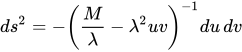
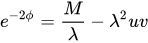
where M is the ADM mass. Singularities appear at uv = λ−3M.
The masslessness of the matter fields allow a black hole to completely evaporate away via Hawking radiation. In fact, this model was originally studied to shed light upon the black hole information paradox.
See also
References
- ^ Callan, Curtis; Giddings, Steven; Harvey, Jeffrey; Strominger, Andrew (1992). "Evanescent black holes". Physical Review D. 45 (4): 1005–1009. arXiv:hep-th/9111056. Bibcode:1992PhRvD..45.1005C. doi:10.1103/PhysRevD.45.R1005. PMID 10014472. S2CID 5840401.
- ^ Grumiller, Daniel; Kummer, Wolfgang; Vassilevich, Dmitri (October 2002). "Dilaton Gravity in Two Dimensions". Physics Reports. 369 (4): 327–430. arXiv:hep-th/0204253. Bibcode:2002PhR...369..327G. doi:10.1016/S0370-1573(02)00267-3. S2CID 119497628.
- ^ Grumiller, Daniel; Meyer, Rene (2006). "Ramifications of Lineland". Turkish Journal of Physics. 30 (5): 349–378. arXiv:hep-th/0604049. Bibcode:2006TJPh...30..349G. Archived from the original on 2011-08-22.
| Central concepts | |||||||||
|---|---|---|---|---|---|---|---|---|---|
| Toy models | |||||||||
| Quantum field theory in curved spacetime | |||||||||
| Black holes | |||||||||
| Approaches |
| ||||||||
| Applications | |||||||||
See also:  Template:Quantum mechanics topics Template:Quantum mechanics topics | |||||||||
 | This article needs additional or more specific categories. (September 2024) |
Content Disclaimer
Informasi ini disarikan dari Wikipedia dan disajikan kembali untuk tujuan edukasi. Konten tersedia di bawah lisensi CC BY-SA 3.0. Kami tidak bertanggung jawab atas ketidakakuratan data yang bersumber dari kontribusi publik tersebut.
- The information displayed on this website is sourced in part or in whole from Wikipedia and has been adapted for the purpose of restating it. We strive to provide accurate and relevant information, however:
- There is no guarantee of absolute accuracy. Wikipedia is an open, collaborative project that can be edited by anyone, so information is subject to change.
- It is not intended to constitute professional advice. The content displayed is for informational and educational purposes only. For important decisions (e.g., medical, legal, or financial), please consult a professional.
- Content copyright. Wikipedia is licensed under the Creative Commons Attribution-ShareAlike License (CC BY-SA). This means that content may be reused with appropriate attribution and shared under a similar license.
- Responsible use. Any risk arising from the use of information from this website is entirely the responsibility of the user.