Booty shake
The booty shake or booty shaking is a generic term for sexually suggestive dance moves that involve fast movements of pelvis. Originating in African dances, booty shaking was brought by African slaves to the United States and other places, and now it is commonly seen at the dance floor. This move is a part of a number particular dances, of which twerking has become a viral international sensation after being performed by Miley Cyrus in 2013. Colloquial expressions, such as "shake your booty" or "shake your ass" refer to this dance move. "Booty-shaking music" is music that makes people to shake their booties.
There is no particular choreography for the move, and as music writer Cristina Jerome puts it, it is "a move that even someone with two left feet can’t screw up".[1]
Dances and dance moves that involve "booty shaking" include mapalé, the gouyad move in méringue of Haiti, "vacunao" ("vaccinate") move of Guaguancó, Cuba, "winin'" (Jamaica),[a], "ventilateur" (Senegal)[b], Niiko (Somalia), kwassa kwassa, zingué (Cameroon), mapouka[c], m'alayah.[5]
Gallery
-

-
-
-
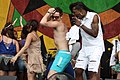 Big Freedia booty shaking contest
 -

-
 Mapalé


See also
- Belly dance
- Erotic dance
- Ndombolo#Dance
- Tamure
- Umbigada (from Portuguese umbigo, "navel"), sometimes translated as "belly bump"
Notes
- ^ "...places a strong emphasis on circular or isolated hip motions known as “winin.”"[2]
- ^ "ventilateur ('electric fan', which describes the motion of the buttocks swirling suggestively)"[3]
- ^ "In the early 2000s, the Cameroonian government had placed bans on certain “indecent” dances such as the zingue and mapouka,[4]
References
- ^ Cristina Jerome, Ten Songs That Will Inspire You to Shake Your Ass
- ^ From Jamaica to NYC
- ^ Tang, Patricia (September 2007). Masters of the Sabar: Wolof Griot Percussionists of Senegal. Philadelphia: Temple University Press. p. 159].
- ^ Lesley Nicole Braun, "Trading Virtue for Virtuosity: The Artistry of Kinshasa's Concert Danseuses", JSTOR 43306257
- ^ Twerk: booty-dancing a white privilege?, February 27, 2014
Further reading
- Kim Jordan, Our Bodies, Our Dances
 | This dance-related article is a stub. You can help Wikipedia by adding missing information. |
Content Disclaimer
Informasi ini disarikan dari Wikipedia dan disajikan kembali untuk tujuan edukasi. Konten tersedia di bawah lisensi CC BY-SA 3.0. Kami tidak bertanggung jawab atas ketidakakuratan data yang bersumber dari kontribusi publik tersebut.
- The information displayed on this website is sourced in part or in whole from Wikipedia and has been adapted for the purpose of restating it. We strive to provide accurate and relevant information, however:
- There is no guarantee of absolute accuracy. Wikipedia is an open, collaborative project that can be edited by anyone, so information is subject to change.
- It is not intended to constitute professional advice. The content displayed is for informational and educational purposes only. For important decisions (e.g., medical, legal, or financial), please consult a professional.
- Content copyright. Wikipedia is licensed under the Creative Commons Attribution-ShareAlike License (CC BY-SA). This means that content may be reused with appropriate attribution and shared under a similar license.
- Responsible use. Any risk arising from the use of information from this website is entirely the responsibility of the user.