Apse


In architecture, an apse (pl.: apses; from Latin absis, 'arch, vault'; from Ancient Greek ἀψίς, apsis, 'arch'; sometimes written apsis; pl.: apsides) is a semicircular recess covered with a hemispherical vault or semi-dome, also known as an exedra. In Byzantine, Romanesque, and Gothic Christian church (including cathedral and abbey) architecture, the term is applied to a semi-circular or polygonal termination of the main building at the liturgical east end (where the altar is), regardless of the shape of the roof, which may be flat, sloping, domed, or hemispherical. Smaller apses are found elsewhere, especially in shrines.[1]
Definition
An apse is a semicircular recess, often covered with a hemispherical vault. Commonly, the apse of a church, cathedral or basilica is the semicircular or polygonal termination to the choir or sanctuary, or sometimes at the end of an aisle.
Smaller apses are sometimes built in other parts of the church, especially for reliquaries or shrines of saints.[citation needed]
History
The domed apse became a standard part of the church plan in the early Christian era.[2]
Related features
In the Eastern Orthodox Church tradition, the south apse is known as the diaconicon and the north apse as the prothesis. Various ecclesiastical features of which the apse may form part are drawn together here.
Chancel
The chancel (or sanctuary), directly to the east beyond the choir, contains the high altar, where there is one (compare communion table). This area is reserved for the clergy, and was therefore formerly called the "presbytery", from Greek presbuteros, "elder", [citation needed] or in older and Catholic usage "priest".[3]
Chevet-apse chapels
Semi-circular choirs, first developed in the East, which came into use in France in 470.[4] By the onset of the 13th century, they had been augmented with radiating apse chapels outside the choir aisle, the entire structure of apse, choir and radiating chapels coming to be known as the chevet (French, "headpiece").[5]
Gallery
-
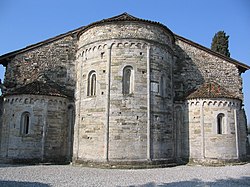 Triple apse of Basilica di Santa Giulia, northern Italy
 -
 East end of the abbey church of Saint-Ouen, showing the chevet, Rouen, Seine-Maritime, France
 -
 A chevet apse vault, Toulouse, France
 -
 Apsed chancel of St Mary's Church, West Dean, Wiltshire, England
 -
 The decorated apse of the Cathedral of Monreale, Sicily
 -
 The apse of Manila Cathedral, Philippines
 -


_-_Voutes.jpg)


_-_Busskirch_St_Martin_IMG_9213_ShiftN.jpg)

See also
- Ambulatory
- Architectural development of the eastern end of cathedrals in England and France
- Byzantine architecture
- Cathedral architecture
- Church architecture
- Narthex
- Niche
- Scarsella
References
- ^ "Basilica of the National Shrine of the Immaculate Conception: Floor Plan". NationalShrine.com. Archived from the original on 9 August 2017. Retrieved 27 August 2016.
- ^ "Apse". Encyclopædia Britannica. Retrieved 10 July 2012.
- ^ "Where in the New Testament are Priests Mentioned". Catholic Answers. Retrieved 1 September 2018.
- ^ Moss, Henry, The Birth of the Middle Ages 395-814, Clarendon Press, 1935
- ^ "Chevet", Encyclopædia Britannica
- Joseph Nechvatal, "Immersive Excess in the Apse of Lascaux", Technonoetic Arts 3, no. 3, 2005.
External links


- Spiers, Richard Phené (1911). . In Chisholm, Hugh (ed.). Encyclopædia Britannica. Vol. 2 (11th ed.). Cambridge University Press. pp. 231–232. This has a detailed description of examples in the early church.
| International | |
|---|---|
| National | |
| Other | |

Content Disclaimer
Informasi ini disarikan dari Wikipedia dan disajikan kembali untuk tujuan edukasi. Konten tersedia di bawah lisensi CC BY-SA 3.0. Kami tidak bertanggung jawab atas ketidakakuratan data yang bersumber dari kontribusi publik tersebut.
- The information displayed on this website is sourced in part or in whole from Wikipedia and has been adapted for the purpose of restating it. We strive to provide accurate and relevant information, however:
- There is no guarantee of absolute accuracy. Wikipedia is an open, collaborative project that can be edited by anyone, so information is subject to change.
- It is not intended to constitute professional advice. The content displayed is for informational and educational purposes only. For important decisions (e.g., medical, legal, or financial), please consult a professional.
- Content copyright. Wikipedia is licensed under the Creative Commons Attribution-ShareAlike License (CC BY-SA). This means that content may be reused with appropriate attribution and shared under a similar license.
- Responsible use. Any risk arising from the use of information from this website is entirely the responsibility of the user.