Almost integer


In recreational mathematics, an almost integer (or near-integer) is any number that is not an integer but is very close to one. Almost integers may be considered interesting when they arise in some context in which they are unexpected.
Almost integers relating to the golden ratio and Fibonacci numbers
Some examples of almost integers are high powers of the golden ratio , for example:
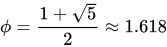
![{\displaystyle {\begin{aligned}\phi ^{17}&={\frac {3571+1597{\sqrt {5}}}{2}}\approx 3571.00028\\[6pt]\phi ^{18}&=2889+1292{\sqrt {5}}\approx 5777.999827\\[6pt]\phi ^{19}&={\frac {9349+4181{\sqrt {5}}}{2}}\approx 9349.000107\end{aligned}}}](https://wikimedia.org/api/rest_v1/media/math/render/svg/517ac892a0426835ff7e4378faf421aeef1d9fdd)
The fact that these powers approach integers is non-coincidental, because the golden ratio is a Pisot–Vijayaraghavan number.
The ratios of Fibonacci or Lucas numbers can also make almost integers, for instance:


The above examples can be generalized by the following sequences, which generate near-integers approaching Lucas numbers with increasing precision:


As n increases, the number of consecutive nines or zeros beginning at the tenths place of a(n) approaches infinity.
Almost integers relating to e and π
Other occurrences of non-coincidental near-integers involve the three largest Heegner numbers:


where the non-coincidence can be better appreciated when expressed in the common simple form:[2]


where

and the reason for the squares is due to certain Eisenstein series. The constant is sometimes referred to as Ramanujan's constant.

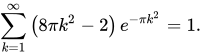
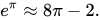
Almost integers that involve the mathematical constants π and e have often puzzled mathematicians. An example is: This can be explained using a sum related to Jacobi theta functions as follows: The first term dominates since the sum of the terms for total The sum can therefore be truncated to where solving for gives Rewriting the approximation for and using the approximation for gives Thus, rearranging terms gives Ironically, the crude approximation for yields an additional order of magnitude of precision.[1]







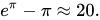

Another example involving these constants is:

See also
References
External links
Content Disclaimer
Informasi ini disarikan dari Wikipedia dan disajikan kembali untuk tujuan edukasi. Konten tersedia di bawah lisensi CC BY-SA 3.0. Kami tidak bertanggung jawab atas ketidakakuratan data yang bersumber dari kontribusi publik tersebut.
- The information displayed on this website is sourced in part or in whole from Wikipedia and has been adapted for the purpose of restating it. We strive to provide accurate and relevant information, however:
- There is no guarantee of absolute accuracy. Wikipedia is an open, collaborative project that can be edited by anyone, so information is subject to change.
- It is not intended to constitute professional advice. The content displayed is for informational and educational purposes only. For important decisions (e.g., medical, legal, or financial), please consult a professional.
- Content copyright. Wikipedia is licensed under the Creative Commons Attribution-ShareAlike License (CC BY-SA). This means that content may be reused with appropriate attribution and shared under a similar license.
- Responsible use. Any risk arising from the use of information from this website is entirely the responsibility of the user.