Activity-driven model

| Part of a series on | ||||
| Network science | ||||
|---|---|---|---|---|
| Network types | ||||
| Graphs | ||||
|
||||
| Models | ||||
|
||||
| ||||

In network science, the activity-driven model is a temporal network model in which each node has a randomly-assigned "activity potential",[1] which governs how it links to other nodes over time.
Each node (out of total) has its activity potential drawn from a given distribution . A sequence of timesteps unfolds, and in each timestep each node forms ties to random other nodes at rate (more precisely, it does so with probability per timestep). All links are then deleted after each timestep.


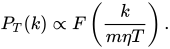
Properties of time-aggregated network snapshots are able to be studied in terms of . For example, since each node after timesteps will have on average outgoing links, the degree distribution after timesteps in the time-aggregated network will be related to the activity-potential distribution by


Spreading behavior according to the SIS epidemic model was investigated on activity-driven networks, and the following condition was derived for large-scale outbreaks to be possible:
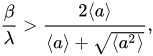
where is the per-contact transmission probability, is the per-timestep recovery probability, and (, ) are the first and second moments of the random activity-rate .


Extensions
A variety of extensions to the activity-driven model have been studied. One example is activity-driven networks with attractiveness,[2] in which the links that a given node forms do not attach to other nodes at random, but rather with a probability proportional to a variable encoding nodewise attractiveness. Another example is activity-driven networks with memory,[3] in which activity-levels change according to a self-excitation mechanism.
References
- ^ Perra, Nicola; B. Gonçalves; R. Pastor-Satorras; A. Vespignani (2012-06-25). "Activity driven modeling of time varying networks".
- ^ Pozzana, Iacopo; K. Sun; N. Perra (2017-10-26). "Epidemic spreading on activity-driven networks with attractiveness". Physical Review E. Vol. 96, no. 4. doi:10.1103/PhysRevE.96.042310.
- ^ Zino, Lorenzo; A. Rizzo; M. Porfiri (2018-12-11). "Modeling Memory Effects in Activity-Driven Networks". SIAM Journal on Applied Dynamical Systems. 17 (4): 2830–2854. doi:10.1137/18M1171485. S2CID 102354985.
Content Disclaimer
Informasi ini disarikan dari Wikipedia dan disajikan kembali untuk tujuan edukasi. Konten tersedia di bawah lisensi CC BY-SA 3.0. Kami tidak bertanggung jawab atas ketidakakuratan data yang bersumber dari kontribusi publik tersebut.
- The information displayed on this website is sourced in part or in whole from Wikipedia and has been adapted for the purpose of restating it. We strive to provide accurate and relevant information, however:
- There is no guarantee of absolute accuracy. Wikipedia is an open, collaborative project that can be edited by anyone, so information is subject to change.
- It is not intended to constitute professional advice. The content displayed is for informational and educational purposes only. For important decisions (e.g., medical, legal, or financial), please consult a professional.
- Content copyright. Wikipedia is licensed under the Creative Commons Attribution-ShareAlike License (CC BY-SA). This means that content may be reused with appropriate attribution and shared under a similar license.
- Responsible use. Any risk arising from the use of information from this website is entirely the responsibility of the user.