Active reflection coefficient
The active reflection coefficient (ARC) is the reflection coefficient for a single antenna element in an array antenna, in the presence of mutual coupling. The active reflection coefficient is a function of frequency in addition to the excitation of the neighboring cells.[1] In computational electromagnetics, the active reflection coefficient is usually determined from unit cell analysis in the frequency domain, where the phase shift over the unit cell (progressive phase shift used to steer the beam) is applied as a boundary condition. It has been suggested that the name "scan reflection coefficient" is more appropriate than "active reflection coefficient",[2] however the latter remains the most commonly used name.
Mathematical description
General case
The ARC for antenna element in an array of elements is calculated by:[3]


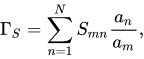
where are the excitation coefficients and are the coupling coefficients.


Linear array with specified scan angle
In a linear array with inter element spacing , uniform amplitude tapering and scan angle , the following excitation coefficients are used: . By inserting this expression into the general equation above, we obtain:[4]




See also
References
- ^ Mailloux, Robert J. (2005). Phased array antenna handbook. Boston: Artech House.
{{cite book}}: CS1 maint: publisher location (link) - ^ Hansen, Robert C (2009). Phased array antennas. John Wiley and Sons. pp. Chapter 7.2.3.
- ^ Hansen, Robert C (2009). Phased array antennas. John Wiley and Sons. pp. Chapter 7.2.3.
- ^ Pozar, D. M. (1994). "The active element pattern". IEEE Transactions on Antennas and Propagation. 42 (8): 1176–1178. Bibcode:1994ITAP...42.1176P. doi:10.1109/8.310010.
Content Disclaimer
Informasi ini disarikan dari Wikipedia dan disajikan kembali untuk tujuan edukasi. Konten tersedia di bawah lisensi CC BY-SA 3.0. Kami tidak bertanggung jawab atas ketidakakuratan data yang bersumber dari kontribusi publik tersebut.
- The information displayed on this website is sourced in part or in whole from Wikipedia and has been adapted for the purpose of restating it. We strive to provide accurate and relevant information, however:
- There is no guarantee of absolute accuracy. Wikipedia is an open, collaborative project that can be edited by anyone, so information is subject to change.
- It is not intended to constitute professional advice. The content displayed is for informational and educational purposes only. For important decisions (e.g., medical, legal, or financial), please consult a professional.
- Content copyright. Wikipedia is licensed under the Creative Commons Attribution-ShareAlike License (CC BY-SA). This means that content may be reused with appropriate attribution and shared under a similar license.
- Responsible use. Any risk arising from the use of information from this website is entirely the responsibility of the user.